Pakistan has emerged as China’s most important partner in air combat capabilities, according to a recent Pentagon assessment submitted to the US Congress this week.
The report underscores China’s expanding role as a major international arms supplier, particularly to developing nations, noting that Beijing continues to leverage defence exports as a key instrument of its broader foreign policy objectives, including initiatives linked to the Belt and Road framework. As of December 2024, China ranked as the world’s fourth-largest exporter of military equipment, with state-owned defence enterprises such as the Aviation Industry Corporation of China and Norinco driving overseas sales through competitive pricing and flexible financing options.
In the field of military aviation, Pakistan is identified as China’s leading partner and primary recipient of Chinese combat aircraft. China currently markets three fixed-wing combat platforms internationally: the fifth-generation FC-31 stealth fighter, the fourth-generation J-10C multirole aircraft, and the JF-17 Thunder, which was jointly designed and developed with Pakistan.
The report notes that Pakistan is the sole operator of the J-10C to date. Since 2020, Pakistan has received 20 aircraft, with total orders standing at 36. While several other countries—including Egypt, Uzbekistan, Indonesia, Iran, and Bangladesh—have shown interest in the platform, no confirmed exports beyond Pakistan have yet materialized.
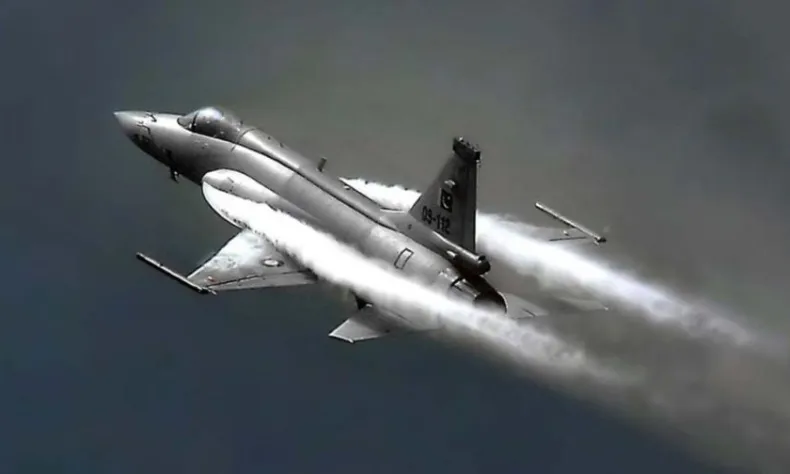
The JF-17 programme is highlighted as a notable example of successful defence cooperation between two developing countries. The aircraft is currently in service with the air forces of Azerbaijan, Myanmar, and Nigeria, and discussions are reportedly underway with Iraq regarding a potential acquisition. For Pakistan, the JF-17 continues to serve as a central component of its air power and a key export offering of its defence industry.
Beyond manned combat aircraft, the report points out that China has supplied Pakistan with advanced armed unmanned aerial vehicles, including systems from the Caihong and Wing Loong series. These platforms have also been exported to multiple other countries, reflecting China’s growing footprint in the global drone market.
China’s defence exports extend across land warfare systems, air defence equipment, and naval platforms. Pakistan has been a longstanding recipient of Chinese naval assets, including four frigates delivered in 2017 and 2018, and is expected to remain a core partner as China continues to expand its naval export portfolio.
According to the Pentagon’s analysis, China’s success in the global arms market is driven by cost-effective solutions, flexible financing arrangements, and limited political conditions. In Pakistan’s case, the defence partnership with China goes well beyond procurement, encompassing joint development, co-production, and sustained strategic cooperation, reflecting a mature and long-standing defence relationship between the two countries.