
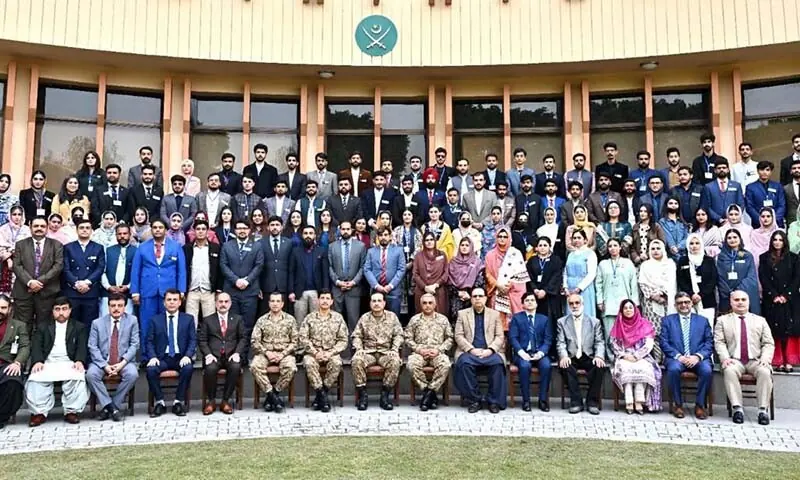
Chief of Defence Forces and Chief of the Army Staff, Field Marshal Asim Munir, on Wednesday cautioned that any attempt to undermine Pakistan’s sovereignty or territorial integrity would invite a strong and unambiguous response.
He made these remarks while addressing participants of the 18th National Workshop on Balochistan at the General Headquarters (GHQ). According to a statement issued by the Inter-Services Public Relations (ISPR), the field marshal drew attention to the persistent efforts of India-backed elements seeking to incite violence and obstruct development initiatives in the province.
Reaffirming the resolve of the armed forces, he stated that such hostile designs would be neutralised through resolute and effective measures, aimed at eliminating terrorism and restoring lasting peace in Balochistan.
The ISPR statement further quoted the army chief as saying that Pakistan remains fully committed to peace and stability in the region. However, he emphasised that any breach of Pakistan’s territorial integrity—whether overt or covert—would be met with a firm and decisive reaction. He added that safeguarding the lives and well-being of citizens remains a foremost priority of the Pakistan Armed Forces.
The military’s media wing noted that the workshop primarily focused on Balochistan’s strategic significance and pathways for its socio-economic advancement. Addressing the gathering, Field Marshal Munir praised the perseverance and sacrifices of the people of Balochistan, underscoring their central role in the country’s overall progress and prosperity.
He also acknowledged the broad spectrum of development initiatives being undertaken jointly by the federal and provincial governments, highlighting a people-focused strategy aimed at improving living standards and harnessing the province’s vast economic potential for the benefit of its residents.
In his address, the army chief commended the contribution of civil society, stressing its importance in countering misinformation and propaganda while supporting sustainable development efforts. He urged all stakeholders to rise above narrow political interests, asserting that Balochistan’s future must be shaped by inclusive growth and long-term stability for its people.
The remarks come against the backdrop of recent violations of Pakistan’s sovereignty by neighbouring countries. In May, tensions escalated with India following an attack on tourists in occupied Kashmir, an incident New Delhi linked to Pakistan without providing evidence. Islamabad categorically rejected the allegations and called for an impartial international investigation.
Despite this, India carried out air strikes on May 7 in parts of Punjab and Azad Kashmir, triggering a four-day military confrontation. Both sides targeted each other’s airbases before diplomatic intervention by the United States on May 10 helped secure a ceasefire.
Relations with Afghanistan also deteriorated in October amid Islamabad’s concerns over cross-border militancy and its demand that Kabul take decisive action against the banned Tehreek-i-Taliban Pakistan (TTP). Following border skirmishes on October 11, a temporary ceasefire was reached after talks in Doha and later Istanbul. However, multiple rounds of negotiations, despite mediation by Türkiye and Qatar, failed to yield a lasting solution.
Pakistan has simultaneously witnessed a surge in terrorist incidents, particularly in Khyber Pakhtunkhwa and Balochistan, since the TTP ended its ceasefire with the government in November 2022. The state has designated certain Balochistan-based militant outfits as Fitna-al-Hindustan, pointing to India’s alleged involvement in destabilising activities inside Pakistan.
Earlier this year, Pakistan was ranked second in the Global Terrorism Index 2025, which reported a 45 per cent increase in fatalities from terrorist attacks compared to the previous year. Published by the Institute for Economics and Peace (IEP), the index analyses global terrorism trends over the past 17 years.