
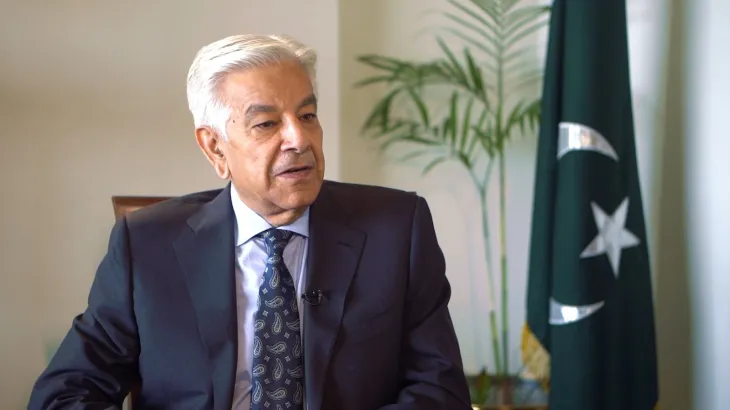
Pakistan will not rule out additional cross-border strikes inside Afghanistan unless Kabul ensures peace, Defence Minister Khawaja Asif said on Wednesday, alleging that Afghanistan and India were jointly fueling terrorism against Pakistan through proxy networks.
Speaking to France 24, Asif claimed that rising militant violence inside Pakistan was being driven by India-backed elements operating with the support of Afghan authorities. He said “nearly all terrorist franchises” had taken refuge in Afghanistan due to Kabul’s unwillingness to act against them.
Asif stressed that Pakistan retained the right to undertake cross-border operations if threats persisted. “We will not hesitate,” he said. “If Kabul can guarantee peace, hostilities won’t occur. But they continue to shelter and enable these groups,” adding that Afghan officials could not deny responsibility for militants launching attacks from their territory.
Referring to last year’s airstrikes inside Afghanistan, Asif said the option remained open. He accused Delhi of pursuing a proxy confrontation after suffering setbacks during a brief military engagement in May, when the Pakistan Air Force repelled an attempted breach of Pakistani airspace.
He said India, the Afghan administration and militant outfits were “aligned” in targeting Pakistan, warning that conflict with India remained “possible” under current conditions.
The minister said Pakistan had pursued diplomatic channels — including meetings in Istanbul, Doha and Kabul — but talks yielded no progress. He said Afghan officials privately conceded that Tehreek-e-Taliban Pakistan members were operating from their soil, acknowledging limited control over extremist factions. “We told them: if you can’t control them, let us take action,” Asif stated.
He accused Kabul of hosting multiple groups, including the East Turkestan Islamic Movement, TTP, Islamic State and Da’esh, as well as smaller networks.
His remarks came after a deadly suicide attack at the Imambargah Khadijatul Kubra in Islamabad that killed 36 and wounded more than 160. Follow-up raids in Nowshera and Peshawar led to the arrest of four facilitators, while the Afghan handler linked to Da’esh was also apprehended. Interior Minister Mohsin Naqvi confirmed the network had been trained in Afghanistan.
Pakistan’s stance on Gaza
Commenting on the Middle East, Asif said Pakistan was prepared to join an international stabilisation force for Gaza, provided clear terms of reference were established. Highlighting Pakistan’s long record in United Nations peacekeeping missions, he said such involvement could help advance efforts toward a two-state solution.
He reiterated that Pakistan would not normalise ties with Israel unless Palestinians secured their right to self-determination and statehood, despite several Muslim states having established relations with Tel Aviv.
Internal dynamics and security outlook
Addressing Pakistan’s own governance structure, Asif described the current setup as a “hybrid arrangement” where national institutions — including the military — work alongside the elected government. Rejecting claims of military dominance, he insisted the armed forces were supporting civilian leadership amid ongoing security and economic challenges.
He acknowledged the historical role of the establishment but said present circumstances required coordinated institutional responses. Asif concluded that Pakistan would continue confronting the proxy threats it faces, cautioning that continued Afghan inaction would leave Islamabad with “no option” but to respond forcefully.
Pakistan has long warned of an Afghanistan–India nexus behind rising militancy, citing increased cross-border attacks. Recent reports by the United Nations also noted growing TTP activity emanating from Afghan territory, reinforcing Pakistan’s long-standing concerns regarding terrorist safe havens.