
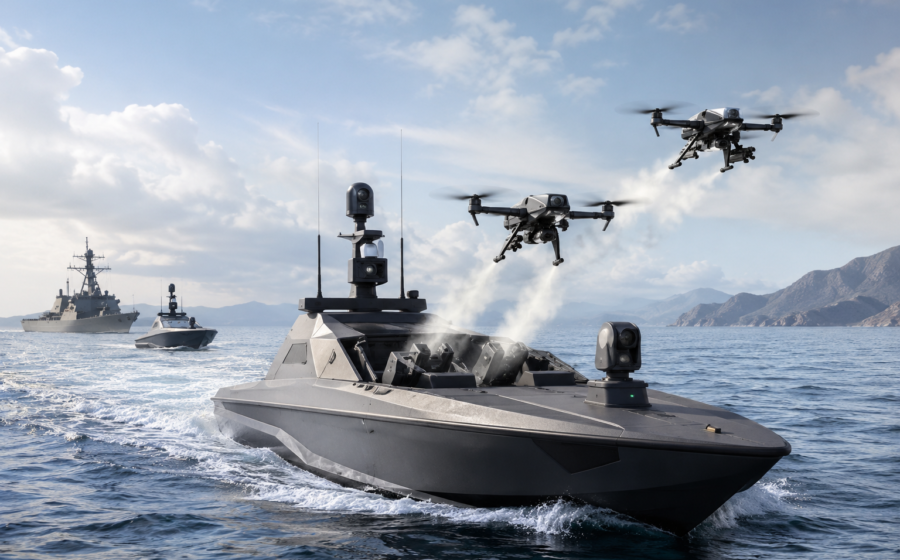
The Pentagon is looking for a new generation of unmanned vessels capable of carrying and launching attack drones, as the United States seeks more affordable ways to counter small boats, unmanned craft and aerial drones in contested maritime environments.
The initiative reflects growing concern that relatively inexpensive unmanned systems can pose serious challenges to conventional naval forces, particularly in strategically sensitive areas such as the Persian Gulf. Instead of relying on costly warships, aircraft or sophisticated missiles against every low-cost threat, the Department of Defense wants systems that can perform surveillance, interception and strike missions at a much lower operating cost.
The Defense Innovation Unit (DIU) has issued a solicitation for the Suitable Warfighting Adaptive Payloads – Unmanned Surface Vessel (SWAP-USV) program. The Pentagon is seeking commercially mature unmanned surface vessels that can be paired with at least two existing aerial drone systems.
A key requirement is speed. The first systems are expected to be sufficiently mature for potential field deployment within approximately 120 days, emphasizing technologies that already exist rather than platforms requiring years of research and development.
$100 Million Challenge to Accelerate Development
DIU plans to run the SWAP-USV effort as a year-long, multi-stage competition offering a total of $100 million in prize funding.
The initiative is intended to bring together maritime manufacturers, autonomous-navigation specialists, sensor companies and unmanned aircraft developers. Rather than developing every component from scratch, the Pentagon is seeking combinations of commercially mature technologies that can quickly be integrated into an operational system.
Companies selected through the competition could have opportunities beyond the prize money. Successful participants may become eligible for follow-on procurement agreements supported by an additional $200 million acquisition budget.
The approach could allow the Pentagon to test several competing technologies before deciding which configurations are suitable for larger-scale procurement.
Pentagon Wants to Change the Cost Equation
One of the central problems behind SWAP-USV is the widening difference between the cost of an incoming threat and the weapon used to defeat it.
Small unmanned boats and drones can be relatively inexpensive to manufacture and deploy in numbers. Countering them with sophisticated naval vessels, aircraft or high-end weapons can create an unfavorable economic exchange for the defender.
DIU therefore wants a system capable of identifying and responding to asymmetric maritime threats without routinely committing multimillion-dollar military platforms.
A network of relatively inexpensive robotic vessels carrying drones could potentially extend surveillance coverage, increase persistence and provide commanders with more options for responding to threats.
Robot Boats Would Carry Multiple UAVs
Under the proposed concept, each unmanned surface vessel would operate as both a maritime platform and a mobile base for aerial drones.
The vessel would need to transport, launch and support at least two small unmanned aerial vehicles. Collectively, those aircraft would need to support a kinetic payload of at least 2 kilograms, or about 4.4 pounds.
The Pentagon is interested in both recoverable UAVs and one-way systems. Depending on their configuration, the drones could perform intelligence, surveillance and reconnaissance missions, relay communications, support electronic warfare, deliver payloads or conduct precision engagements against designated targets under operator control.
This would give a single unmanned boat the ability to combine persistent surface operations with the greater reach and flexibility provided by airborne systems.
Designed for Oceans, Coastal Areas and Rivers
The Pentagon does not want SWAP-USV systems restricted to open-ocean missions.
Potential platforms are expected to operate across maritime environments that could include coastal waters and riverine areas. Persistence is another important consideration, with systems expected to remain on station while keeping operating costs, logistics requirements and personnel demands as low as practical.
The autonomous vessel would also be expected to perform surveillance and interdiction missions within assigned operating areas.
One desired capability is the ability to follow or shadow a vessel identified as being of interest. The Pentagon is also seeking the capability to intercept vessels that refuse to cooperate and continue maneuvering.
Greater autonomy in carrying out these functions is preferred, although the solicitation does not make completely autonomous execution mandatory.
Smuggling Boats and Semi-Submersibles Among Potential Threats
The range of threats identified by DIU extends beyond conventional military targets.
High-speed smuggling vessels and semi-submersible craft are among the types of targets contemplated by the program. Semi-submersibles have been used by trafficking organizations to move illicit cargo because their low profiles can make them more difficult to detect at sea.
A persistent unmanned platform equipped with sensors and aerial drones could potentially search larger maritime areas without requiring continuous deployment of crewed aircraft or warships.
That gives SWAP-USV possible relevance not only in high-intensity military operations but also in maritime surveillance and interdiction missions.
Pentagon Wants Systems That Can Be Rapidly Transported
Mobility is another major requirement.
The Defense Department wants candidate systems that can be transported using standard logistics infrastructure. Proposed platforms should therefore be compatible with options such as standard shipping containers, road trailers and military transport aircraft, including the C-17 and C-130.
Systems capable of operating from less-developed launch sites or offering flexible deployment options are expected to receive additional consideration.
DIU is also emphasizing production maturity. The aerial drones proposed for integration should already be technically developed and supported by an established manufacturing capability.
This requirement suggests the Pentagon is prioritizing systems that can transition rapidly from evaluation to production if they perform successfully.
Three Sprints Planned Through 2027
The competition is divided into three phases, described as “sprints,” with funding distributed across each stage.
Sprint 1 is expected to move particularly quickly. In-water testing is planned for fall 2026, and the objective is to demonstrate technology capable of reaching operational deployment within roughly 120 days. Teams selected for this stage will need to provide a mission-ready unmanned vessel with integrated drone capability for evaluation within 29 days of selection. Up to $40 million in prize funding is allocated to the first phase.
Sprint 2 is also backed by $40 million. Submissions are expected during fall 2026, followed by testing in early 2027. This phase is expected to explore broader payload options, improved autonomy and integration of technologies supplied by different manufacturers.
Sprint 3 is planned to begin accepting submissions in early 2027, with maritime testing expected in summer 2027. DIU has yet to disclose all of the technical objectives for this stage. The final sprint carries $20 million in prize funding.
Companies can indicate which sprint best matches the maturity of their technology, although the government may place participants into different cohorts depending on their technical readiness and ability to manufacture systems at the required scale.
Unmanned Systems Could Reshape Maritime Operations
SWAP-USV highlights a broader shift toward combining different classes of unmanned platforms rather than treating aerial and maritime drones as separate capabilities.
A robot boat capable of independently patrolling an assigned area while carrying its own UAVs could effectively serve as a mobile launch and surveillance platform. Multiple vessels operating together could potentially expand coverage while reducing dependence on larger crewed assets.
The Pentagon’s emphasis on commercially mature hardware, rapid integration and existing production capacity also indicates that the immediate priority is fielding practical capabilities rather than pursuing a lengthy development program.
If the competition succeeds, the resulting systems could give U.S. forces a lower-cost way to detect, track and respond to small maritime threats while preserving expensive aircraft, ships and weapons for missions where their capabilities are genuinely required.