
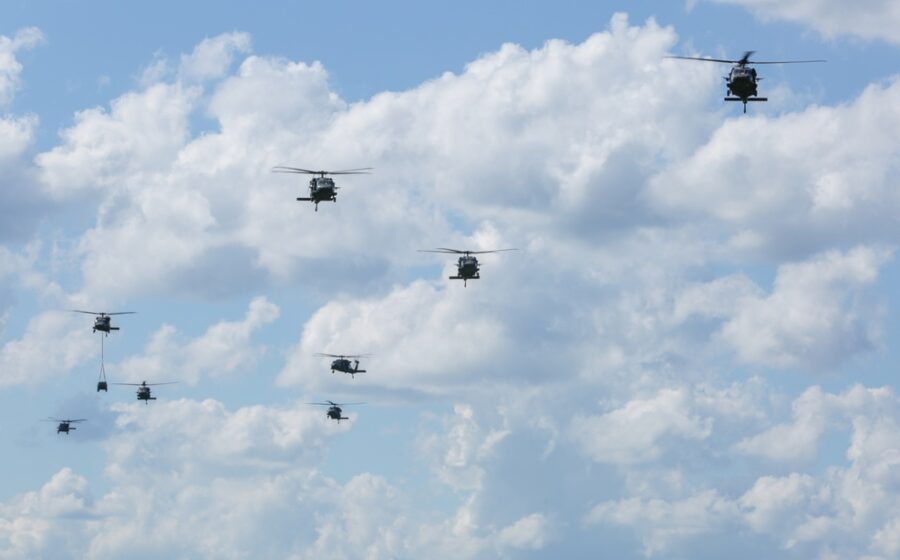
Rotary-wing aircraft occupy a unique niche in military aviation, combining the ability to hover, operate from unprepared terrain and deliver firepower or troops precisely where fixed-wing aircraft cannot reach. From high-altitude mountain warfare to urban counter-insurgency operations, military helicopters remain indispensable across the full spectrum of modern conflict.
Attack Helicopters: Precision Firepower on Rotors
Dedicated attack helicopters such as the American AH-64 Apache, the Bell AH-1Z Viper and Russia’s Mi-28 and Ka-52 combine cannons, guided anti-tank missiles and rockets with sophisticated targeting sensors to provide close air support and anti-armour capability. Their ability to operate at low altitude, using terrain to mask their approach, makes them particularly effective in mountainous and cluttered terrain where fixed-wing jets struggle to acquire and engage fleeting ground targets.
Transport and Utility Helicopters
Utility and transport helicopters, led by the ubiquitous Mi-17 family and the American UH-60 Black Hawk, form the logistical backbone of ground operations, ferrying troops, evacuating casualties and resupplying remote outposts that would otherwise require days of overland travel through hostile or difficult terrain. Their versatility has made them equally valuable in disaster relief and humanitarian operations alongside pure combat missions.
Pakistan’s Rotary-Wing Fleet
Pakistan Army Aviation operates a mixed fleet that has historically included the Bell AH-1 Cobra, progressively supplemented and replaced by the AH-1Z Viper along with Chinese-origin attack helicopters, reflecting Islamabad’s effort to diversify suppliers amid shifting geopolitical alignments. These attack helicopters, paired with Mi-17 and other utility variants, have played a central role in counter-insurgency operations across the rugged terrain of the former FATA region and Khyber Pakhtunkhwa, where helicopters provide rapid troop insertion, close air support and medical evacuation in areas inaccessible to wheeled or tracked vehicles.
Helicopters in Counter-Insurgency Warfare
The mountainous terrain along Pakistan’s western border has repeatedly demonstrated the value of helicopters in irregular warfare, where militants often operate from remote, fortified positions in valleys and ridgelines. Attack and transport helicopters operating together allow security forces to rapidly encircle and clear such positions, providing precision fire support while inserting and extracting troops well beyond the reach of road networks, often under fire.
Emerging Trends: Teaming With Drones
A significant shift now underway across major militaries involves pairing manned attack helicopters with unmanned aerial systems in a manned-unmanned teaming concept, where drones scout ahead and designate targets while the helicopter crew remains at a safer stand-off distance. This approach reduces risk to aircrew while extending the reach and persistence of rotary-wing operations, a trend that is likely to influence future helicopter fleet modernization decisions across South Asia.
Conclusion
Despite the rise of fixed-wing drones and precision-guided artillery, military helicopters retain a role that no other platform can fully replace: the ability to deliver firepower and personnel precisely, flexibly and close to the ground. For Pakistan’s armed forces, continued investment in modern attack and utility helicopters will remain essential to operations across its varied and often unforgiving terrain.