
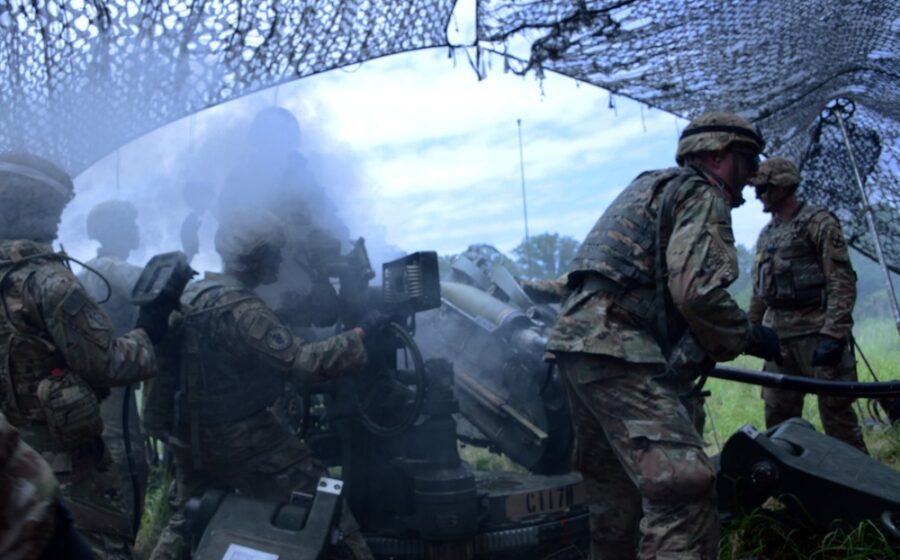
Often called the king of battle, artillery remains the single largest source of casualties in conventional ground conflict, and recent wars have only reinforced its enduring importance. From towed howitzers to long-range rocket systems and precision-guided shells, modern artillery has evolved far beyond the massed, unguided barrages of earlier eras.
Towed and Self-Propelled Howitzers
Towed howitzers remain valued for their relatively low cost, ease of transport by air, and suitability for mountainous or infrastructure-poor terrain, while self-propelled howitzers, mounted on tracked or wheeled chassis, offer superior mobility and crew protection, allowing batteries to shoot and rapidly relocate before counter-battery fire can strike back. Pakistan’s artillery inventory spans both categories, including domestically produced and Chinese-origin self-propelled systems such as the SH-15, alongside a range of towed 155mm and 130mm systems that form the backbone of its field artillery regiments.
Rocket Artillery and Long-Range Fires
Multiple launch rocket systems provide a different capability entirely, delivering a high volume of firepower across a wide area or, with modern guided rockets, precision strikes at ranges extending well beyond conventional tube artillery. Pakistan has fielded systems such as the A-100 multiple rocket launcher, providing the Army with long-range strike capability that can reach key targets and troop concentrations far behind the immediate front line.
Precision-Guided Artillery Munitions
Perhaps the most significant recent evolution in artillery has been the proliferation of precision-guided shells and rockets, which use GPS or laser guidance to strike targets with far greater accuracy than traditional unguided munitions. This precision dramatically reduces the number of rounds needed to neutralize a target, easing logistics burdens while reducing the risk of collateral damage, an important factor in operations near populated areas or along contested borders.
Counter-Battery Radar and Survivability
As artillery has grown more lethal, so too has the ability to detect and rapidly return fire against enemy batteries using counter-battery radar systems that calculate an incoming shell’s point of origin within seconds. This has driven a premium on rapid displacement after firing, sometimes called shoot-and-scoot tactics, making self-propelled and mobile rocket systems increasingly valuable compared to slower, towed alternatives in contested environments.
Artillery Along the Line of Control
Artillery exchanges have periodically flared along the Pakistan-India Line of Control and international border, underscoring how, even in an era of precision missiles and drones, traditional tube and rocket artillery remains a primary tool for both signalling resolve and inflicting attrition during periods of heightened tension, requiring both sides to maintain robust counter-battery and force protection measures for forward-deployed troops and civilians alike.
Conclusion
Far from being rendered obsolete by precision airpower and missiles, artillery continues to provide the sustained, flexible firepower that ground commanders rely on in nearly every conflict scenario. For Pakistan’s armed forces, modernizing artillery with precision munitions, improved mobility and integrated counter-battery radar will remain a key priority for maintaining credible ground force capability.