
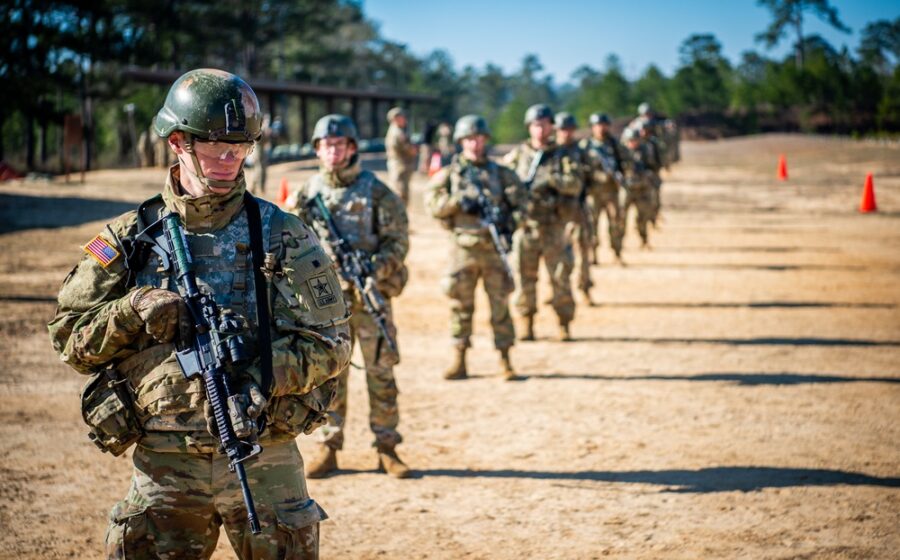
Despite the growing prominence of drones, precision missiles and cyber warfare, the individual infantry soldier armed with a rifle, machine gun or anti-tank weapon remains the ultimate arbiter of ground control in most conflicts. Infantry weapons continue to evolve steadily, balancing lethality, weight, ergonomics and logistics to meet the demands of increasingly complex battlefields.
Assault Rifles and Individual Weapons
The assault rifle remains the fundamental tool of the modern infantryman, and Pakistan’s Ordnance Factories have long produced licensed and modified variants of established designs to equip the country’s armed forces while supporting export sales. Ongoing modernization efforts across many militaries emphasize lighter composite materials, improved ergonomics, and modular accessory rails that allow soldiers to attach optics, lasers and other sighting aids suited to specific mission requirements.
Machine Guns and Sustained Fire Support
Squad and platoon-level machine guns provide the sustained volume of fire that allows infantry units to suppress enemy positions while manoeuvring, and general-purpose machine guns remain a mainstay of infantry sections across virtually every modern army. Heavier, crew-served machine guns extend this suppressive capability further, often mounted on vehicles or fixed defensive positions to cover key approaches.
Anti-Tank Guided Missiles
The proliferation of man-portable anti-tank guided missiles has transformed the vulnerability calculus for armoured vehicles on the modern battlefield, as demonstrated repeatedly in recent conflicts where relatively inexpensive guided missiles have destroyed main battle tanks costing many times more. Pakistan’s infantry and anti-tank units field a range of guided missile systems designed to counter armoured incursions, reflecting the enduring importance of this weapon category in a region where large mechanized formations remain central to conventional war planning.
Man-Portable Air Defence Systems
Shoulder-fired surface-to-air missiles give infantry units an organic capability to threaten low-flying aircraft, helicopters and drones without relying on dedicated air defence batteries, extending a measure of protection to forward troops operating beyond the coverage of larger air defence radars and missile systems.
The Soldier Modernization Trend
Many armed forces, including Pakistan’s, are pursuing integrated soldier modernization programmes that combine improved body armour, load-bearing equipment, night vision and communication systems into a cohesive package designed to improve individual survivability and battlefield awareness. This holistic approach recognizes that infantry effectiveness depends not just on the weapon itself but on the full ecosystem of protection, communication and situational awareness equipment carried by each soldier.
Conclusion
Infantry weapons may lack the technological glamour of fighter jets or missile systems, but they remain absolutely central to controlling and holding ground, the ultimate objective of most military campaigns. Continued investment in modern rifles, anti-armour systems and integrated soldier equipment will remain essential for Pakistan’s infantry forces operating across diverse terrain from high-altitude glaciers to dense urban environments.