
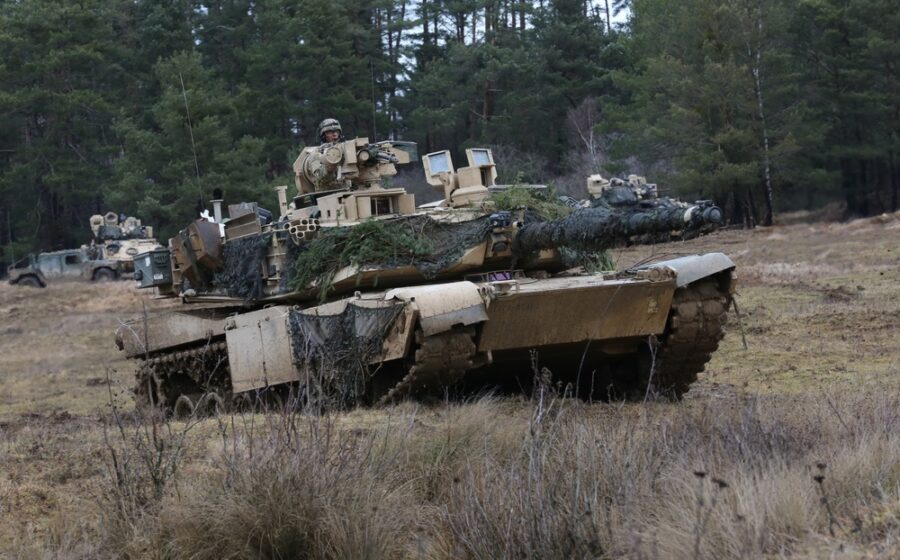
Despite repeated predictions of its obsolescence in the face of guided anti-tank missiles and loitering munitions, the main battle tank continues to anchor the ground combat power of virtually every serious military. Modern armour doctrine has adapted rather than abandoned the tank, pairing it with active protection systems, improved sensors and combined-arms tactics to survive on an increasingly lethal battlefield.
Pakistan’s Armoured Backbone
The Pakistan Army’s armoured corps centres on the indigenously assembled Al-Khalid main battle tank, developed jointly with China and produced domestically at Heavy Industries Taxila, alongside the more recently acquired VT-4 tanks that bring further improvements in protection, fire control and mobility. This combination gives Pakistan a credible modern armoured force capable of contesting the plains of Punjab and Sindh, terrain historically considered the most likely theatre for large-scale mechanized engagements in any conventional conflict with India.
The Regional Armour Balance
India’s armoured forces field a mix of Russian-origin T-90 tanks and the indigenously developed Arjun, alongside older T-72 variants undergoing incremental upgrades. This creates a regional armour competition where both sides continuously seek improvements in firepower, protective armour and fire control systems to maintain an edge, or at least parity, in any potential large-scale mechanized engagement.
Infantry Fighting Vehicles and Mechanized Forces
Beyond tanks themselves, infantry fighting vehicles allow mechanized infantry to keep pace with advancing armour while providing protected transport and supporting firepower through onboard cannons and anti-tank missiles. These vehicles form an essential part of combined-arms formations, ensuring infantry can dismount to clear terrain unsuitable for tanks while remaining under armoured protection during movement to contact.
The Anti-Armour Threat Environment
The proliferation of guided anti-tank missiles and top-attack loitering munitions has forced armour designers to rethink protection strategies, moving beyond passive armour thickness toward active protection systems that detect and intercept incoming projectiles before impact. Recent conflicts have demonstrated starkly that tanks operating without adequate infantry support, air cover or active protection face severe vulnerability to ambush by relatively inexpensive guided weapons.
Active Protection and the Future of Armour
Active protection systems, already fielded by several advanced militaries, represent the next major evolution in tank survivability, using radar or infrared sensors to detect incoming missiles and rockets, then launching countermeasures to destroy or deflect them before impact. As these systems mature and proliferate, they are likely to become a standard feature on next-generation main battle tanks, including any future upgrades to Pakistan’s armoured fleet.
Conclusion
Rather than disappearing from the battlefield, tanks and armoured fighting vehicles continue to evolve, incorporating new protection technologies and networked sensors to remain relevant against modern anti-armour threats. For Pakistan, sustaining a credible, modernized armoured force through continued indigenous production and selective foreign acquisition remains a cornerstone of conventional deterrence along its eastern border.