
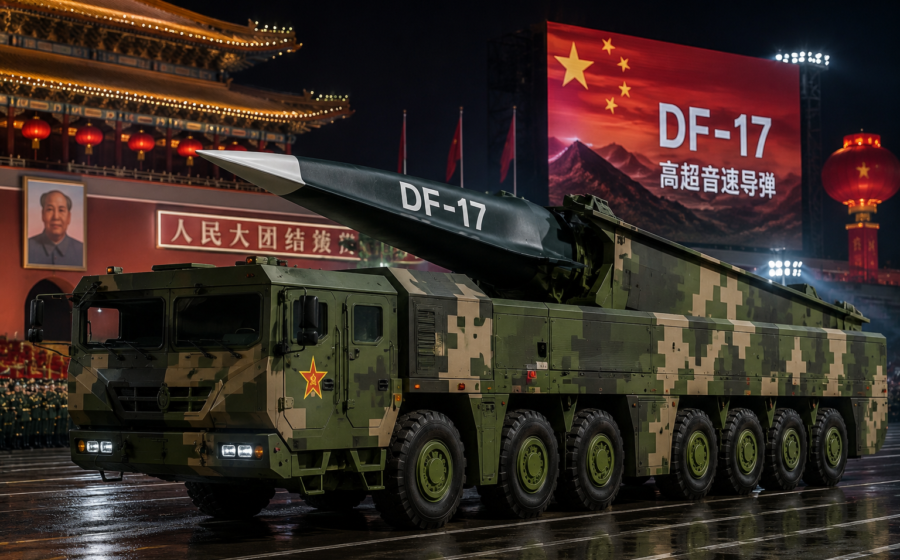
China’s Dong Feng-17 ballistic missile, believed to have existed for more than a decade, was showcased for the first time on official Chinese state media in June, described as one of the country’s premier military assets and accompanied by English-language subtitles detailing its battlefield capabilities.
Analysts say the broadcast responds to recent Asia-Pacific military exercises conducted by other nations and is intended to signal to the U.S. military that the missile, commonly known as the DF-17, carries the ability to inflict significant damage in the event of a conflict with China. Alexander Huang, chairman of the Council of Strategic and Wargaming Studies in Taipei, said the footage may represent political signaling or mild deterrence, noting the missile is especially difficult to defend against, particularly when aimed at large surface targets.
The DF-17 is a medium-range missile fitted with a hypersonic glide vehicle, enabling it to fly at lower altitudes along unpredictable flight paths. According to a paper from the Center for Strategic and International Studies in Washington, the missile has existed for at least 12 years and has been fielded by the People’s Liberation Army since 2019.
The missile’s public unveiling coincided with the ongoing 2026 Rim of the Pacific exercises near Hawaii and separate U.S.-Japan drills held in late June. Chen Yi-fan, assistant professor at Taiwan’s Tamkang University, said the timing was intended to demonstrate the PLA’s growing confidence in its ability to overwhelm regional missile-defense systems and complicate the operational planning of potential adversaries. State broadcaster CGTN described the missile as capable of ultra-precise strikes able to penetrate advanced defense systems, launched without reliance on fixed sites and usable in any weather conditions.
The CSIS paper describes the DF-17 as roughly 11 meters in length with a range of 1,800 to 2,500 kilometers, capable of carrying either conventional or nuclear payloads. China is estimated to possess around 1,300 such missiles and 300 launchers. Chen said the DF-17, as one of the PLA’s premier strategic assets, is likely reserved for the most consequential scenarios, including any foreign military intervention perceived as supporting Taiwan’s independence.
M. Taylor Fravel, director of the Security Studies Program at the Massachusetts Institute of Technology, said the missile’s hypersonic glide vehicle gives it a distinct advantage in combat, making it considerably harder to intercept than a traditional ballistic missile and more capable of penetrating missile defenses. Huang noted that earlier Dong Feng-series missiles followed a conventional surface-to-surface flight path, making their trajectories comparatively easier to predict than that of the DF-17.
American installations in Hawaii, Guam and Japan continue to monitor increased PLA naval activity around Taiwan, alongside ongoing tension between Beijing and the Philippines over contested territory in the South China Sea. Analysts suggested that U.S. forces may need to expand long-range radar capabilities to detect DF-17 launch sites and respond effectively in any future conflict, with Fravel noting that Washington is already developing comparable systems, including the Army’s Long-Range Hypersonic Weapon.
The unveiling of the DF-17 underscores Beijing’s continuing efforts to demonstrate advanced missile capabilities amid heightened regional tension, while reinforcing calls from analysts for the United States to accelerate development of its own hypersonic weapons to maintain credible deterrence.