
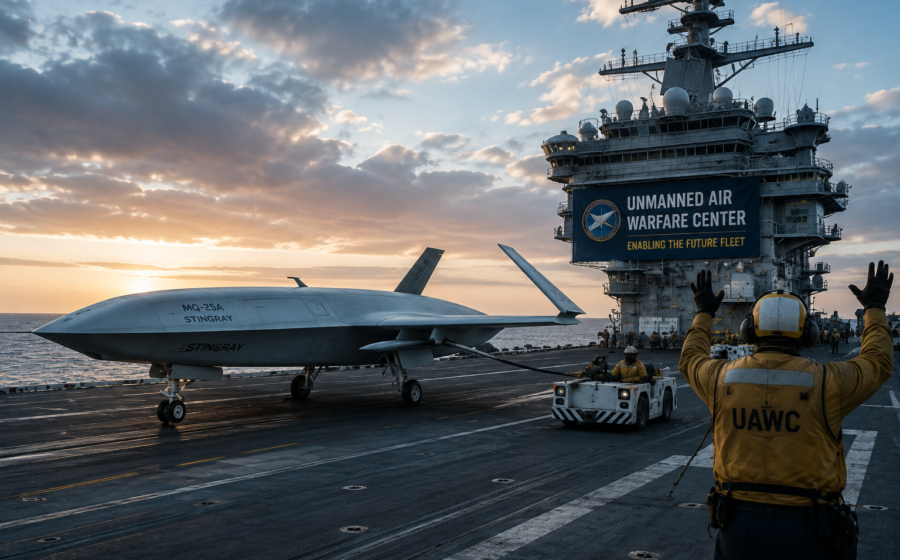
The USS Theodore Roosevelt has become the first U.S. Navy aircraft carrier equipped with an Unmanned Air Warfare Center (UAWC) capable of supporting operations involving the Boeing MQ-25A Stingray, the Navy’s first operational carrier-based unmanned aircraft.
Acting Navy Secretary Hung Cao announced in May that the MQ-25A had entered the low-rate initial production and deployment stage during testimony before the Senate Armed Services Committee.
The Stingray is being developed primarily to provide aerial refueling for carrier air wings. By taking over the tanker mission, the unmanned aircraft is expected to allow F/A-18E/F Super Hornets to spend more time performing combat and strike missions rather than serving as aerial refueling aircraft.
A Pentagon acquisition document dated April 21, 2026, and recently released as part of its Modernized Selected Acquisition Report provides additional details about the program. The report states that the Theodore Roosevelt’s Unmanned Air Warfare Center became fully operational and deployable for MQ-25 missions in March 2026.
Another carrier, the USS Ronald Reagan, is expected to have its own operational UAWC by the end of August 2026.
The Theodore Roosevelt is not the first carrier to receive the technology. The Nimitz-class USS George H.W. Bush became the first aircraft carrier to have a UAWC installed and tested when the system was placed aboard the ship in August 2024.
The Navy says two key components are necessary to operate and control the MQ-25. These include the Unmanned Carrier Aviation Mission Control System and the MD-5E Ground Control Station. Together, the systems provide the command-and-control capabilities needed to operate the unmanned tanker from an aircraft carrier.
The MQ-25 program reached another major milestone in May when it achieved Milestone C. Within the U.S. defense acquisition system, this approval allows a program to move from engineering and manufacturing development into the production and deployment stage.
The milestone represents a significant step forward for a program that has been under development for several years.
The Navy and Boeing signed an $805 million contract in 2018 covering the design, development, production, testing and delivery of four initial Stingray aircraft. At the time, Navy estimates indicated that acquiring a planned fleet of 72 aircraft could eventually cost approximately $13 billion.
The MQ-25 program has experienced delays during development. Its first flight occurred later than originally scheduled, but the aircraft continued making progress toward operational service.
On April 25, 2026, a Stingray completed an approximately two-hour test flight in the vicinity of Mascoutah, Illinois. The flight marked another important step in the aircraft’s development and evaluation.
With the USS Theodore Roosevelt now equipped to support MQ-25 operations, the Navy has moved closer to deploying the unmanned refueling aircraft from an operational carrier.
The development represents an important shift in carrier aviation, as the Navy increasingly integrates unmanned aircraft alongside its traditional manned fleet. The MQ-25 is expected to extend the effectiveness of carrier-based aviation by handling the refueling mission while allowing manned fighter aircraft to remain available for their primary combat roles.