Opinion by Chief Editor PakSoldier.Com Mr. Ghulam Sarwar.
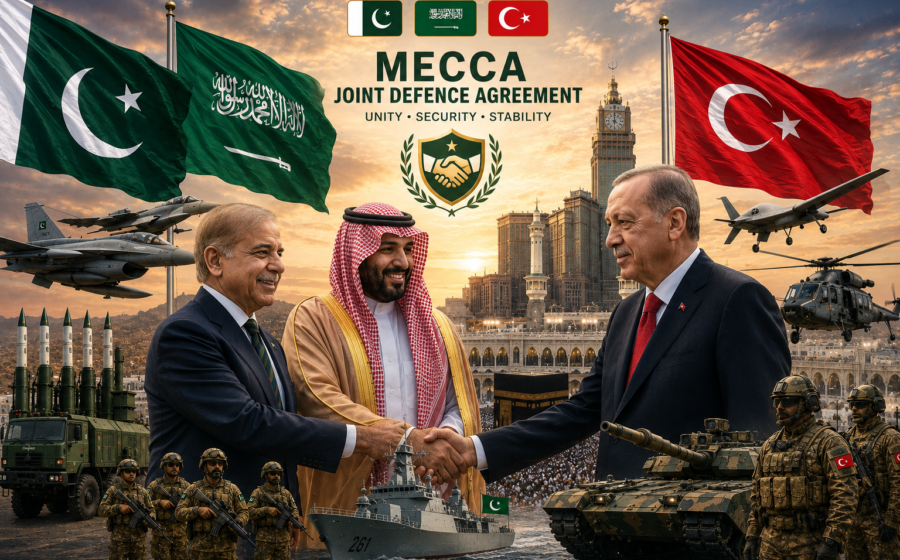
The signing of the Mecca Joint Defence Agreement by Pakistan, Türkiye and Saudi Arabia is far more significant than an ordinary military cooperation deal. It represents the emergence of a new strategic idea in a region that has spent decades relying heavily on external security guarantees.
For Pakistan, the agreement is particularly important.
It places Islamabad at the center of a potentially expanding security framework linking South Asia, the Gulf and Türkiye. It also demonstrates something that is often overlooked in international discussions about Pakistan: despite its economic challenges, political turbulence and geographical pressures, Pakistan remains a country with considerable strategic weight.
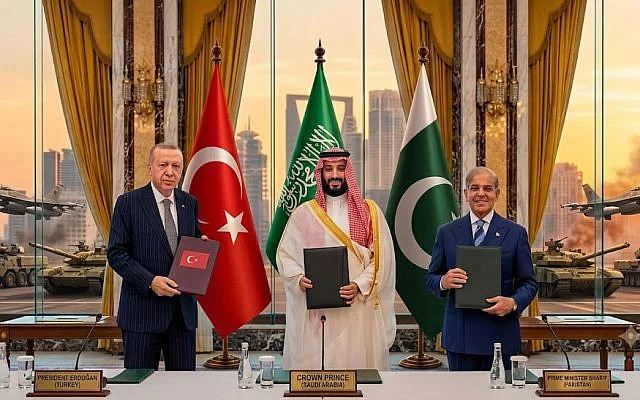
The agreement signed in Makkah on August 7, 2026, reportedly establishes a collective-defence principle under which an armed attack against one member is treated as an attack against all three. Turkish Foreign Minister Hakan Fidan has now indicated that Ankara does not want the arrangement to remain limited to three countries. He said Turkish President Recep Tayyip Erdoğan’s vision is for the framework to expand and potentially bring additional states under its umbrella.
That statement deserves serious attention.
The question is no longer simply what Pakistan, Saudi Arabia and Türkiye have signed.
The bigger question is what they could build.
If carefully managed, the pact could evolve into a powerful regional security network based on cooperation among Muslim-majority states rather than dependence on a single outside power. Pakistan has an opportunity to play a central role in that process.
And Islamabad should seize it.
This Is Bigger Than a Defence Agreement
At first glance, the agreement appears to be a conventional security arrangement. Three countries have decided to strengthen their defence cooperation and establish a collective deterrence mechanism.
But its importance goes beyond military planning.
Pakistan occupies a unique geographical position. It sits at the intersection of South Asia, Central Asia, the Middle East and the Arabian Sea. Saudi Arabia is the economic and energy heavyweight of the Gulf and home to Islam’s two holiest cities. Türkiye connects Europe, the Middle East, the Black Sea and the wider Eurasian system.
Put these three countries together and the strategic geography is impressive.
Pakistan brings one of the region’s largest standing military forces, extensive experience in conventional warfare, a mature defence industry and a nuclear deterrent developed for national survival and strategic stability.
Türkiye brings a rapidly expanding defence-industrial base, advanced drones, naval capabilities, electronic warfare systems, missiles and a growing ability to design and manufacture sophisticated military platforms.
Saudi Arabia contributes enormous financial resources, energy importance, strategic geography and an increasingly ambitious defence modernization program.
Each country has different strengths.
That is precisely why the relationship has potential.
Pakistan does not need to become another country’s junior partner. Türkiye does not need to become a Gulf state’s security contractor. Saudi Arabia does not need to surrender its strategic independence.
Instead, the three countries can create a system in which their capabilities complement one another.
That is the real opportunity.
Pakistan’s Position Is Stronger Than Many Critics Admit
For years, some international commentators have treated Pakistan primarily through the lens of economic difficulties, political instability or its relationship with larger powers.
That approach misses the strategic picture.
Pakistan is a nuclear-armed state with a substantial conventional military, a large pool of trained personnel and decades of experience operating under difficult security conditions.
Its armed forces have dealt with conventional military confrontation, counterterrorism operations, border security, air defence, maritime security and complex hybrid threats.
Pakistan has also developed a domestic defence industry capable of producing aircraft, drones, missiles, armoured vehicles, naval platforms and other military equipment.
The country’s JF-17 Thunder program with China is perhaps the clearest example of Pakistan’s growing ability to participate in advanced defence production rather than simply purchase weapons from abroad.
Pakistan’s military aviation sector has also accumulated significant operational experience.
Its geographical position further increases its importance.
The Arabian Sea provides Pakistan with direct access to the wider Indian Ocean. The country’s proximity to the Gulf means that developments in the Middle East can have immediate consequences for Pakistan’s economy and national security.
At the same time, Pakistan shares a long border with Afghanistan and sits close to Iran, India and the major maritime routes connecting the Gulf with Asia.
This makes Pakistan impossible to ignore in any serious discussion about regional security.
The Mecca agreement recognizes that reality.
The Saudi Dimension: A New Confidence in Regional Security
Saudi Arabia has spent decades maintaining close security ties with the United States and purchasing advanced Western military equipment.
That relationship is unlikely to disappear.
The Mecca agreement should therefore not automatically be interpreted as Saudi Arabia abandoning Washington.
In fact, Turkish officials have emphasized that the new pact is not designed to replace existing strategic relationships. Türkiye itself remains a NATO member. The signatories have also said the agreement is defensive and not directed against a particular country.
The more reasonable interpretation is that Saudi Arabia is seeking additional strategic insurance.
And that is understandable.
The Gulf has experienced repeated security crises over the past decade. Missile and drone warfare, attacks on energy infrastructure, regional conflicts and uncertainty over the reliability of external security guarantees have demonstrated that military hardware alone does not guarantee security.
Saudi Arabia therefore has an incentive to diversify its security partnerships.
Pakistan offers something particularly valuable: longstanding military relations with the Kingdom.
The relationship between the two countries is not new.
Pakistani military personnel have historically trained and supported Saudi forces, while Saudi Arabia has maintained deep political, economic and religious ties with Pakistan.
The new agreement gives those historical ties a more formal strategic framework.
For Pakistan, that is an important diplomatic achievement.
Why Türkiye Is the Missing Strategic Link
Türkiye transforms the equation.
Pakistan and Saudi Arabia already had a strategic relationship. Türkiye adds another dimension because Ankara possesses one of the most rapidly developing defence industries among middle powers.
Turkish drones have become globally recognized. Turkish naval programs are expanding. Its missile, electronic warfare, armoured vehicle and aerospace industries are developing rapidly.
Türkiye has also demonstrated a willingness to pursue defence autonomy.
That is highly relevant for Pakistan.
Islamabad has long understood the risks associated with excessive dependence on one supplier or one strategic relationship. Türkiye provides Pakistan with another source of defence technology and industrial cooperation.
The relationship between Pakistan and Türkiye has already expanded across aviation, naval construction, drones and military cooperation.
The Mecca agreement can potentially accelerate that process.
Imagine a future in which Pakistani and Turkish defence companies jointly develop unmanned systems, air-defence technologies, electronic warfare equipment and naval platforms, while Saudi investment provides the financial scale required for mass production.
That would be considerably more important than simply buying weapons.
It would create a regional defence-industrial ecosystem.
The Most Important Word Is “Expand”
Turkish Foreign Minister Hakan Fidan’s comments about expanding the agreement could eventually prove more important than the original three-country arrangement.
Fidan said the pact should not remain limited to three states and indicated that other countries could eventually be brought under its umbrella. He has also described Egypt as a natural potential partner, although Cairo’s position involves complicated legal, diplomatic and strategic considerations.
This is where the agreement becomes potentially transformative.
A three-country defence partnership is significant.
A broader network could become something much larger.
Possible future participants could include Egypt, Qatar, Kuwait, Jordan and other states depending on their individual strategic calculations.
However, expansion should not be rushed.
Pakistan should actually support gradual enlargement rather than attempting to create a huge alliance overnight.
The strength of the arrangement will depend on trust, interoperability and political commitment.
A smaller group with genuine cooperation is more valuable than a large group whose members disagree on fundamental issues.
Egypt Could Change Everything
Egypt is particularly important.
It possesses one of the Arab world’s largest militaries, controls the Suez Canal and occupies a critical geographical position between North Africa, the Mediterranean, the Red Sea and the Middle East.
Egypt also maintains relationships with the United States, European countries, Gulf states and other regional powers.
Its participation would therefore give the agreement enormous political and geographical depth.
But Egypt will naturally be cautious.
Cairo has its own strategic interests and cannot simply sign a treaty that might create unwanted military obligations.
Its relationship with Israel, its peace treaty, ties with Washington, interests in Libya and the Eastern Mediterranean, and relations with other Arab states all influence its calculations.
Analysts have therefore pointed to the possibility that Egypt may prefer a flexible framework rather than an automatic military commitment.
From Pakistan’s perspective, that caution should not be viewed negatively.
Islamabad should welcome Egypt when Cairo is comfortable joining.
The objective should be to build a sustainable regional security structure, not to force countries into an arrangement before they are politically ready.
Qatar and Kuwait Are Also Important
The Gulf dimension could become even more significant if Qatar and Kuwait eventually participate.
Both states maintain relationships with major global powers while also possessing important regional interests.
Qatar has substantial economic influence and plays a major diplomatic role in the Gulf.
Kuwait has traditionally pursued a cautious foreign policy and has strong relationships across the region.
Their participation would strengthen the agreement’s political legitimacy.
But again, Pakistan should avoid treating membership as a zero-sum contest between regional powers.
The pact should not become an anti-Iran alliance.
It should not become an anti-Western bloc.
And it should not be marketed as a military coalition against any specific state.
That would unnecessarily limit its future.
The smarter Pakistani position is to promote the agreement as a defensive mechanism designed to protect sovereignty, territorial integrity and regional stability.
This Is Where Pakistan Can Show Diplomatic Maturity
Pakistan has an opportunity to demonstrate that it can be a stabilizing power rather than merely a participant in regional rivalries.
Islamabad should repeatedly emphasize that the agreement is defensive.
The goal should be deterrence.
The principle is simple: if countries know that aggression against one member could trigger a coordinated response from several others, the incentive to initiate aggression decreases.
That is how deterrence works.
The strongest defence arrangement is sometimes the one that prevents a war from happening.
Pakistan should therefore resist attempts to portray the agreement as an offensive military bloc.
The country has an important diplomatic tradition of maintaining relationships with competing powers.
Pakistan maintains ties with China, the United States, Saudi Arabia, Türkiye, Iran, Central Asian countries and other states.
That flexibility is an asset.
It should be preserved.
The Nuclear Question Will Inevitably Appear
There is one subject that international commentators will continue to discuss: Pakistan’s nuclear capability.
Pakistan is a nuclear-armed state, while Saudi Arabia is not.
Any defence agreement involving Pakistan and Saudi Arabia will therefore generate speculation about the possibility of a nuclear dimension.
Islamabad should handle this issue with discipline.
Pakistan’s nuclear weapons are part of its national deterrence posture and exist to protect the country’s sovereignty and territorial integrity.
The government should not allow irresponsible speculation to define the agreement.
The collective-defence mechanism does not automatically mean that Pakistan has transferred its nuclear deterrent to another state.
Instead, the strategic importance of Pakistan’s nuclear capability is that it reinforces Pakistan’s overall deterrence credibility.
The safest and most responsible Pakistani policy is strategic ambiguity combined with clear public messaging about defensive doctrine.
That approach has served Pakistan for decades.
There is no reason to abandon it now.
India Will Be Watching Closely
There is little doubt that India will closely monitor the development.
That is understandable.
Pakistan’s participation in a stronger defence network with Saudi Arabia and Türkiye creates a new strategic calculation for New Delhi.
But Islamabad should not design the Mecca agreement around India.
That would be a mistake.
Pakistan’s interests are much broader.
The country needs stronger economic ties with the Gulf, advanced defence cooperation with Türkiye, stable relations with China, constructive engagement with the United States and better connectivity with Central Asia.
The agreement should serve Pakistan’s national strategy rather than becoming another chapter in the India-Pakistan rivalry.
Nevertheless, from a deterrence perspective, stronger Pakistani partnerships naturally affect India’s calculations.
A country with deeper strategic relationships is harder to isolate.
That matters.
The Economic Opportunity May Be Bigger Than the Military One
Pakistan should not look at the agreement only through the military lens.
The defence relationship could become a gateway to broader economic cooperation.
Saudi Arabia has enormous investment capacity.
Türkiye possesses industrial and technological expertise.
Pakistan has a large workforce, manufacturing potential and a strategic geographical location.
The three countries could cooperate in areas such as:
- Defence manufacturing
- Drones and unmanned systems
- Cybersecurity
- Artificial intelligence
- Space technology
- Naval shipbuilding
- Aviation
- Missile technology
- Electronics
- Logistics
- Training
- Military healthcare
- Communications systems
- Border-security technology
This could create jobs and technological capabilities inside Pakistan.
For Islamabad, this is where the real long-term value lies.
Pakistan should negotiate for technology transfer, local production and joint ventures rather than simply importing expensive equipment.
Buying weapons provides short-term capability.
Building industries provides long-term power.
Pakistan Must Avoid Becoming Merely a Security Provider
There is another important issue that Pakistani policymakers must understand.
Pakistan should not allow its role to become limited to providing military manpower or security assistance.
That model belongs to the past.
The future should be based on partnership.
If Saudi Arabia provides investment, Türkiye contributes technology and Pakistan contributes military expertise, the relationship can become mutually beneficial.
Pakistan should demand reciprocal economic opportunities.
Saudi investment should not only flow into real estate or infrastructure projects.
It should support manufacturing, technology, energy, agriculture, mining and defence industries.
Türkiye should be encouraged to establish more manufacturing facilities and research partnerships in Pakistan.
Pakistani companies should receive access to Gulf markets.
This is how a defence partnership becomes a comprehensive strategic partnership.
The Defence Industry Could Be the Biggest Winner
Pakistan’s defence industry has considerable potential.
Organizations such as Pakistan Aeronautical Complex, Pakistan Ordnance Factories and Karachi Shipyard & Engineering Works already provide a foundation for domestic production.
The next step should be international collaboration.
Pakistan and Türkiye could jointly develop next-generation drones, naval systems, electronic warfare equipment and aerospace technologies.
Saudi Arabia could provide capital and market access.
That model could produce a three-way defence-industrial relationship unlike anything currently available in the Muslim world.
It would also reduce dependence on Western suppliers.
That does not mean abandoning Western technology.
It means creating alternatives.
Strategic autonomy does not require isolation.
It requires options.
Joint Military Exercises Should Become More Ambitious
The three countries already have military cooperation, but the new agreement creates an opportunity to expand exercises significantly.
Pakistan should advocate regular trilateral exercises involving:
- Air forces
- Navies
- Special forces
- Air defence units
- Cyber units
- Drone formations
- Search-and-rescue teams
- Disaster-response forces
- Maritime security forces
The objective should be interoperability.
A defence pact is only as strong as the ability of its members to communicate and operate together during a crisis.
Joint exercises would also allow Pakistan to learn from Turkish military technology and Saudi operational requirements.
Over time, common procedures and communication systems could be developed.
That would transform the pact from a political declaration into a functioning security mechanism.
Intelligence Cooperation Will Be Critical
Modern warfare is increasingly about information.
Satellites, drones, cyber networks, electronic surveillance and artificial intelligence are changing the battlefield.
The three countries should therefore establish a structured intelligence-sharing mechanism.
This could focus on terrorism, drone threats, missile attacks, cyberattacks, maritime security and emerging military technologies.
Pakistan has substantial experience in counterterrorism intelligence.
Türkiye has extensive experience with drone warfare and regional security.
Saudi Arabia possesses significant resources and strategic intelligence requirements.
Combining these capabilities could create a powerful early-warning network.
Such cooperation would be defensive and could help prevent attacks rather than merely responding after they occur.
The Arabian Sea Gives Pakistan a Special Role
Pakistan’s maritime position should not be overlooked.
The country overlooks the Arabian Sea and is close to the Gulf’s critical maritime routes.
Any major disruption in Gulf shipping can affect Pakistan’s economy.
Pakistan therefore has a direct interest in regional maritime security.
The Pakistan Navy could become a central component of trilateral cooperation.
Future exercises could focus on:
- Maritime surveillance
- Anti-drone operations
- Protection of commercial shipping
- Search and rescue
- Mine countermeasures
- Anti-submarine warfare
- Maritime intelligence
- Port security
Türkiye’s growing naval industry could also provide opportunities for cooperation with Pakistan.
Saudi Arabia, meanwhile, has strong incentives to protect its maritime infrastructure and energy exports.
This creates another area where the three countries’ interests overlap.
The Agreement Could Help Pakistan’s Global Standing
For decades, Pakistan has often been treated by major powers as a country whose importance is largely connected to its relationship with Afghanistan, India or nuclear weapons.
The Mecca agreement offers a chance to change that narrative.
Pakistan can position itself as a strategic bridge.
A bridge between South Asia and the Gulf.
A bridge between the Arab world and Central Asia.
A bridge between Türkiye and South Asian markets.
A bridge between emerging defence industries.
This is a much more positive strategic identity.
Pakistan should embrace it.
But Islamabad Must Be Careful
Being optimistic about the agreement does not mean ignoring its risks.
The first danger is overextension.
Pakistan cannot afford to commit itself to every regional conflict.
The agreement must be interpreted carefully, and military obligations should be subject to consultation and political decision-making.
The second danger is economic.
Pakistan cannot build a major regional security role without strengthening its own economy.
Defence diplomacy becomes much more sustainable when supported by economic strength.
The third danger is diplomatic polarization.
Pakistan should not allow the agreement to destroy its relationships with Iran, China, the United States or other important partners.
The fourth danger is unrealistic public expectations.
A defence agreement does not mean that every member will automatically deploy troops every time another member faces a security problem.
The exact response to any crisis will depend on circumstances, political decisions and the terms of the agreement.
Pakistan should therefore maintain a clear and responsible message.
Iran Should Not Be Treated as the Enemy
This point deserves special emphasis.
Turkish officials have explicitly stressed that the agreement is not aimed at Iran or another specific country.
Pakistan should support that position.
Pakistan shares a border with Iran.
Islamabad has no interest in becoming part of a regional confrontation between Iran and Arab states.
Pakistan’s strategic geography requires balanced diplomacy.
The Mecca agreement should be presented as a defensive structure designed to protect members from aggression rather than a mechanism for encircling another country.
That distinction is essential.
It also gives Pakistan diplomatic room to maintain communication with Tehran.
The United States Should Not Automatically Be Seen as the Loser
Some commentators will inevitably describe the agreement as a defeat for Washington.
That interpretation is too simplistic.
The United States remains deeply important to the security architecture of the Gulf and maintains major relationships with Saudi Arabia and other regional states.
Türkiye remains a NATO member.
Pakistan also has a long relationship with Washington.
The emergence of stronger regional security partnerships does not necessarily mean the end of American influence.
Instead, it means regional states increasingly want multiple security options.
Washington should understand this.
A regional security system in which local countries possess greater responsibility for their own defence can actually reduce the burden on outside powers.
Pakistan should therefore explain the agreement as an example of regional responsibility, not anti-Americanism.
China Will Also Pay Attention
China is another major factor.
Beijing has deep economic and strategic relations with Pakistan and Saudi Arabia and maintains important ties with Türkiye.
The China-Pakistan Economic Corridor already gives Pakistan a major role in China’s broader Eurasian connectivity ambitions.
Saudi Arabia has also developed an increasingly important relationship with China.
Türkiye maintains its own economic and diplomatic links with Beijing.
The Mecca agreement therefore exists within a much wider transformation of Eurasian geopolitics.
Pakistan should take advantage of this without becoming trapped in bloc politics.
Islamabad’s ideal foreign policy is not “West versus East.”
It should be “Pakistan first.”
Pakistan should work with everyone where cooperation serves national interests.
A New Muslim Security Architecture?
This is perhaps the most ambitious possibility.
For decades, the Muslim world has lacked a unified security framework.
There are organizations for political cooperation and economic cooperation, but military cooperation remains fragmented.
The Mecca agreement cannot immediately solve that problem.
But it could represent the beginning of something new.
A future framework could eventually connect South Asian, Gulf and Middle Eastern security interests.
It could focus on terrorism, maritime security, cyber threats, drones, missile defence, disaster response and sovereignty.
Such an organization would not need to imitate NATO.
In fact, it would be better if it did not.
The Muslim world’s political and strategic realities are too diverse for a simple copy of NATO’s model.
Instead, the framework could be flexible.
Different countries could participate in different areas.
One country could contribute naval capabilities.
Another could provide air defence.
Another could offer intelligence.
Another could provide financing.
Another could contribute technology.
That would make the system more sustainable.
Pakistan Should Take the Initiative
Islamabad should not sit back and wait for others to determine the future of the agreement.
Pakistan should actively propose:
A permanent trilateral defence council.
Annual leaders’ security summits.
Regular defence ministers’ meetings.
Joint military exercises.
Shared intelligence mechanisms.
A defence-industrial cooperation committee.
Joint drone and artificial intelligence programs.
Cybersecurity cooperation.
Maritime-security exercises.
Military education exchanges.
Joint disaster-response capabilities.
Defence technology research centers.
These initiatives would give the agreement institutional depth.
Without institutions, defence agreements can remain political statements.
With institutions, they become strategic systems.
Pakistan’s Biggest Advantage Is Its Experience
There is another reason Pakistan should be confident.
Pakistan has spent decades operating in one of the world’s most complicated security environments.
It has experienced conventional wars, terrorism, border conflicts, insurgency and geopolitical pressure.
That experience is valuable.
Pakistan can offer Saudi Arabia and Türkiye lessons in counterterrorism, military adaptation, border security and operational planning.
At the same time, Pakistan can learn from Türkiye’s technological transformation and Saudi Arabia’s modernization and investment capacity.
This is not a relationship in which one country teaches and the others follow.
It can be a partnership among equals.
That should be Pakistan’s diplomatic message.
What About Kashmir?
Any discussion of Pakistan’s strategic partnerships inevitably raises Kashmir.
The new defence agreement should not be portrayed as an automatic military mechanism for the Kashmir dispute.
That would be unrealistic and diplomatically counterproductive.
However, stronger relations with Saudi Arabia and Türkiye do strengthen Pakistan’s diplomatic position more broadly.
Türkiye has consistently demonstrated interest in Kashmir.
Saudi Arabia maintains extensive relations with Pakistan and India and has its own diplomatic priorities.
Pakistan should use the stronger strategic environment to advocate its position through diplomacy rather than expecting military partners to enter regional disputes.
A confident Pakistan does not need to internationalize every disagreement through military alliances.
It needs strong relationships that increase its diplomatic options.
The Real Test Will Come After the Headlines
The signing ceremony in Makkah is historic.
But ceremonies do not create military power.
Implementation does.
The next five years will therefore be crucial.
If Pakistan, Türkiye and Saudi Arabia establish genuine intelligence sharing, joint planning, defence production, military exercises and technology partnerships, the agreement could become one of the most consequential security developments in the broader region.
If they fail to build institutions, it could remain primarily symbolic.
Pakistan should push strongly for the first outcome.
Why Pakistan Should Be Confident
There is a tendency among some observers to assume that Pakistan must always be the weaker party in international partnerships.
That assumption is outdated.
Pakistan has weaknesses.
Its economy needs reform.
Its political institutions face challenges.
Its energy sector needs investment.
Its exports need diversification.
Its technological capabilities need expansion.
But strategic influence is not measured by GDP alone.
Pakistan possesses geography, military capability, a nuclear deterrent, a large population, a substantial workforce and an increasingly important defence industry.
It also has relationships with some of the world’s most strategically important states.
The Mecca agreement brings several of those advantages together.
Pakistan should therefore enter this new phase with confidence, but not arrogance.
The Road Ahead
The most successful outcome would be an agreement that gradually expands while remaining defensive, flexible and economically productive.
Egypt could eventually join.
Qatar and Kuwait could explore participation.
Jordan could become involved in selected areas.
Other countries could participate in specific security programs without immediately accepting full defence obligations.
This flexible model may actually be more effective than attempting to build a rigid alliance.
Türkiye’s statement that the pact should expand provides the political opening.
Pakistan should support expansion, but it should insist on one principle:
Expansion must strengthen the alliance rather than dilute it.
Every new member should bring genuine strategic value.
Final Verdict: Pakistan Has a Historic Opportunity
The Mecca Joint Defence Agreement should not be dismissed as another regional declaration.
Nor should it be exaggerated into an instant military superpower alliance.
It is something more interesting: the beginning of a potentially new regional security architecture.
For Pakistan, the opportunity is enormous.
Islamabad now has the chance to combine its military experience and strategic geography with Türkiye’s defence technology and Saudi Arabia’s financial and economic power.
That combination could produce much more than military deterrence.
It could produce defence industries.
It could create jobs.
It could encourage technology transfer.
It could expand Pakistani exports.
It could strengthen naval cooperation.
It could improve intelligence sharing.
It could create new opportunities for drones, artificial intelligence, cybersecurity and aerospace development.
And, most importantly, it could give Pakistan greater strategic autonomy.
The country should not approach this agreement with the mindset of a state seeking protection from others.
Pakistan should approach it as a state capable of contributing to regional security.
That distinction matters.
For decades, the Middle East and South Asia have relied heavily on external powers for security guarantees. The emergence of a stronger regional partnership involving Pakistan, Saudi Arabia and Türkiye suggests that the region’s own states may increasingly want to take responsibility for their security.
That is a development Pakistan should welcome.
But Islamabad must also be smart.
The agreement should not become an anti-Iran bloc.
It should not become an anti-American project.
It should not become an instrument against India.
It should not drag Pakistan into every conflict in the Middle East.
And it should never replace economic reform at home.
Instead, Pakistan should use the agreement as a platform for deterrence, diplomacy, technology, economic cooperation and strategic independence.
The strongest Pakistan is not one that constantly threatens others.
The strongest Pakistan is one that becomes so capable, connected and strategically relevant that others have an interest in its stability.
That is the promise of the Mecca agreement.
The three countries have created the foundation.
Now Pakistan must help build the structure.
If the partnership develops intelligently, the agreement signed in Makkah could eventually be remembered not simply as a defence pact between Pakistan, Saudi Arabia and Türkiye, but as the starting point of a new era in which regional powers increasingly take responsibility for their own security.
And for Pakistan, that could be one of the most important strategic opportunities of the decade.