
This opinion is written by Ghulam Sarwar Chief, Editor, PakSoldier.com.
There is something deeply misleading about the way Balochistan is discussed in Pakistan. We usually encounter the province through fragments: a terrorist attack in one district, a security operation in another, a protest somewhere else, a statement from ISPR, a response from a separatist organization, an accusation of foreign interference, a debate about missing persons and, occasionally, a new CPEC announcement. Each story arrives, dominates the news cycle for a few hours and then disappears. Balochistan, however, does not disappear. Its problems remain, its strategic importance continues to grow and the security challenge continues to evolve. That is why the latest wave of violence deserves to be understood as something considerably larger than another chapter in Pakistan’s long counterterrorism struggle.
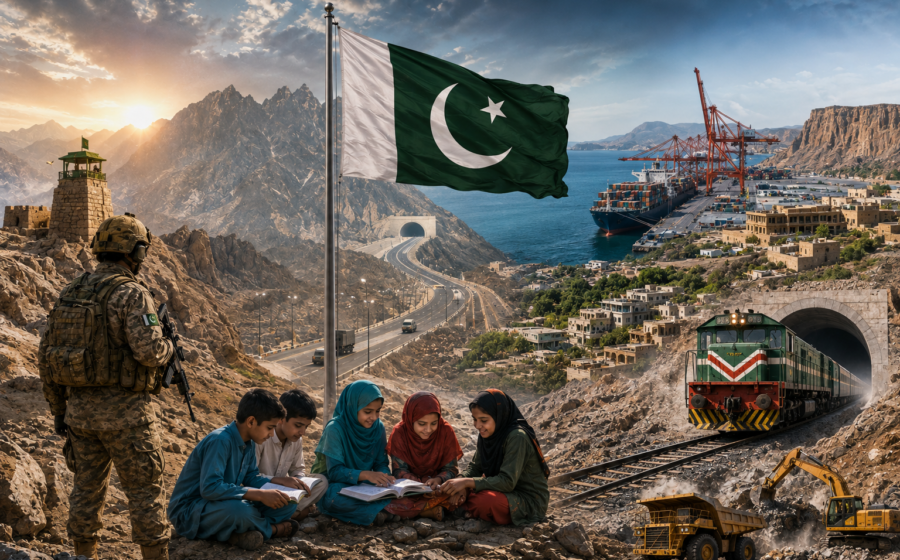
Balochistan is simultaneously Pakistan’s most difficult security challenge and one of its greatest strategic opportunities. It is the province of Gwadar, the Arabian Sea, CPEC, Reko Diq and enormous mineral potential. It connects Pakistan geographically with Iran and Afghanistan and places the country close to the Gulf, Central Asia and some of the world’s most important trade routes. Yet the same geography that gives Balochistan extraordinary strategic value has also made it vulnerable to militancy, smuggling, political instability and foreign competition. Pakistan is therefore fighting on more than one battlefield. There is the physical battle against armed separatist organizations, the political battle over legitimacy, the economic battle over development and investment, and an increasingly important information war being fought on social media and international platforms.
The first thing that needs to be said without hesitation is that Balochistan is Pakistan. An armed organization does not acquire the right to dismantle a country because it claims to represent an ethnic cause. A militant group does not become the representative of an entire population because it produces propaganda videos or attracts international media attention. A passenger train does not become a legitimate military target because the attackers call themselves freedom fighters, and the murder of a policeman, soldier, railway passenger or Chinese engineer does not become legitimate resistance simply because the attacker invokes political grievances. Political disagreement is a legitimate part of national life; terrorism is not. Pakistan has every right to defend its territorial integrity, its citizens, its infrastructure and its national interests against armed organizations that choose violence.
But there is an equally important point that Pakistan must understand. The Baloch people are not the BLA. Balochistan is not a terrorist organization. Millions of Baloch citizens are ordinary Pakistanis who want the same basic things that citizens everywhere want: security, employment, education, healthcare, electricity, clean water, functioning roads, political representation and a dignified future for their children. They should not be viewed collectively through the lens of militancy. In fact, they are among the most important partners Pakistan has in defeating terrorism. An insurgency becomes difficult to sustain when the population refuses to provide recruits, information, money, shelter and social legitimacy to armed groups. The state therefore has to isolate terrorists from the population rather than allowing the entire population to feel isolated from the state.
That distinction is essential because the Balochistan question has a history that cannot simply be erased. The region had its own political structures long before the creation of Pakistan, including the Khanate of Kalat and various tribal and administrative arrangements that existed during British rule. The events surrounding the partition of British India and the accession of Kalat remain the subject of competing historical interpretations. Pakistan’s position is that Balochistan became part of the country through a legitimate political and constitutional process, while Baloch nationalist narratives have interpreted parts of that history differently. A mature Pakistan should have no fear of acknowledging that disagreement. Historical questions can be studied, debated and argued over without surrendering the country’s present constitutional order or allowing armed organizations to impose their preferred interpretation through violence.
The history of Balochistan also shows that Pakistan has faced several periods of armed unrest rather than one uninterrupted conflict. There were confrontations in the early years after independence, further insurgencies during the 1950s and 1960s, and a major conflict during the 1970s. The modern insurgency emerged under a very different set of political and regional circumstances and has developed its own characteristics. The lesson from this history is not that every generation of violence is identical. It is that the causes, organizations, tactics and geopolitical environment of the conflict have repeatedly changed. Pakistan therefore cannot rely on a single formula. What worked against one generation of insurgents may not work against a networked organization operating through social media, sophisticated propaganda, urban cells, financial networks and attacks designed to generate international attention.
The contemporary militant threat is considerably more sophisticated than the old image of a small group of fighters hiding in remote mountains. Organizations such as the Balochistan Liberation Army and Baloch Liberation Front have developed capabilities that include coordinated attacks, propaganda operations, recruitment, financing, psychological warfare and attacks designed specifically to create economic and political consequences. Their targets have increasingly included security forces, government installations, railway infrastructure, highways, civilians and Chinese nationals. That evolution matters because it shows that the insurgency is no longer simply about controlling territory. It is also about creating fear, undermining confidence in the state, disrupting economic activity and convincing domestic and international audiences that Pakistan cannot guarantee security in one of its most strategically important provinces.
The January 2026 attacks demonstrated this changing character of the threat. Coordinated violence across multiple locations was intended not simply to inflict casualties but to create the perception of simultaneous instability. The objective of such attacks is psychological as much as physical. Militants want television screens filled with images of explosions, social-media feeds filled with uncertainty and international audiences asking whether the Pakistani state remains capable of controlling its territory. They want investors to worry about security, Chinese companies to question operational risks and ordinary citizens to believe that the state is always one step behind. This is modern insurgency. The battlefield is no longer limited to a mountain pass or a remote district. It includes railway lines, highways, ports, financial systems, mobile phones and international newsrooms.
The March 2025 Jaffar Express hijacking provided another warning about how the conflict has evolved. A passenger train was attacked after railway infrastructure was sabotaged, and civilians were taken hostage. Pakistani security forces eventually ended the siege and rescued hostages, but the strategic significance of the incident went far beyond the immediate operation. A railway represents more than a transportation system. It connects the state, the economy and the population. When terrorists attack a passenger train, they are attacking the idea that ordinary people can move safely through their own country. They are also demonstrating to the outside world that they can disrupt major infrastructure and create an international crisis using relatively limited resources. Pakistan’s response therefore has to focus not only on what happens during such an attack but on how the state can prevent militants from acquiring the intelligence, logistics and freedom of movement necessary to stage one in the first place.
The attacks that continued during 2026 reinforced the same message: the insurgency remains capable of inflicting casualties and creating pressure despite years of counterterrorism operations. Pakistan’s security forces have demonstrated an ability to respond with force and conduct intelligence-based operations, and their sacrifices deserve recognition. But tactical success should not be confused with strategic victory. A militant commander killed today is important, but a young man who no longer considers militancy an attractive future is more important. A terrorist hideout destroyed is necessary, but a community that refuses to provide another hideout is decisive. A weapons cache recovered is valuable, but a financial network permanently dismantled is even more valuable. The real measure of success is not simply how many militants have been eliminated; it is whether the system that produces new militants is gradually being dismantled.
This is why Pakistan needs to think about Balochistan as a hybrid security challenge. Intelligence-led counterterrorism remains essential, but it must operate alongside professional policing, border management, financial investigations, strategic communication, political engagement and economic development. The state has to understand the networks behind the violence rather than simply responding to individual attacks. Who provides money? Who moves weapons? Who recruits? Who transports people? Who manages communications? Who provides safe houses? Who creates propaganda? Who connects local militants with external networks? These questions matter because modern insurgencies are networks, and networks are defeated by dismantling their connections.
There should also be no hesitation in acknowledging the sacrifices of Pakistan’s security forces. Soldiers of the Pakistan Army and Frontier Corps, police officers, Levies personnel, intelligence officials and other security personnel have repeatedly confronted armed groups in extremely difficult terrain. Many have lost their lives protecting roads, checkpoints, government installations, civilians and strategic projects. The men standing at a checkpoint in Balochistan are not responsible for every political dispute in Islamabad or Quetta. The police officer protecting a railway station is not responsible for the entire history of Pakistan’s federal-provincial relationship. The soldier killed in an ambush is not responsible for every development failure in the province. It is therefore unfair to turn the security personnel fighting terrorism into symbols of every political disagreement that exists in Balochistan.
At the same time, supporting the security forces does not mean pretending that the military can solve every aspect of the problem. No army can permanently substitute for civilian governance. The military can clear an area, secure a road, dismantle a militant network and create the security environment necessary for normal life, but it cannot permanently replace schools, courts, hospitals, local governments and elected institutions. The long-term objective should therefore be a stronger civilian state that can operate safely because the security environment has improved. Pakistan needs the formula of military security, professional policing, effective civilian administration and economic development working together. The Army should create the space in which civilian institutions can function, and civilian institutions must then use that space to build lasting stability.
The question of foreign interference is another major part of the Balochistan conflict and one that Pakistan cannot afford to ignore. Pakistan’s military and government have repeatedly accused hostile foreign intelligence networks, particularly India, of supporting Baloch militant organizations. Pakistani officials have alleged that external actors provide various combinations of funding, weapons, intelligence, training, communications support and logistical assistance. India has rejected such accusations. This is a serious geopolitical dispute and it should be handled with evidence rather than emotional rhetoric. If Pakistan possesses intelligence demonstrating external financing, weapons transfers, communications between militants and foreign handlers or logistical networks operating across borders, Islamabad should document that evidence and present it to the international community wherever security considerations allow.
Pakistan’s position becomes stronger when it demonstrates rather than merely alleges. If there is a financial transfer, trace it. If a weapon has a verifiable origin, establish it. If communications reveal a relationship between an armed group and an external handler, document the chain of evidence. If a militant leader operates from outside Pakistan, explain how the network functions. This is how a serious state builds an international case. At the same time, Pakistan should recognize that foreign interference can exploit internal weaknesses only when those weaknesses exist. Even if hostile actors are supporting militants, Pakistan still has to ask why recruitment is possible, why propaganda finds an audience and why some communities remain vulnerable to alienation. Blaming outsiders without fixing internal vulnerabilities would be an incomplete national-security strategy.
There is obvious geopolitical logic behind attempts to destabilize Balochistan. The province contains Gwadar, sits on the Arabian Sea, forms a major part of CPEC and possesses enormous mineral potential. It is therefore closely connected to Pakistan’s relationship with China and to the country’s ambitions for regional connectivity. A prolonged security crisis in Balochistan can increase the cost of projects, discourage investors, threaten foreign workers, disrupt transport and weaken confidence in Pakistan’s ability to provide a secure environment for international business. None of this means that every attack automatically proves a foreign conspiracy. It means that the strategic value of Balochistan creates incentives for Pakistan’s competitors to exploit instability if opportunities arise.
That is precisely why CPEC should be understood as a Pakistani national interest rather than simply a Chinese investment program. China is a major strategic partner, but CPEC is ultimately intended to contribute to Pakistan’s own connectivity, infrastructure and economic development. Gwadar, roads, energy projects, logistics infrastructure, industrial development and related investments can create opportunities for Pakistan if they are properly managed. The attacks on Chinese citizens therefore have consequences for Pakistan itself. When a Chinese worker is killed, the immediate victim may be Chinese, but the resulting security concerns affect future investment, project timelines, insurance costs, employment and Pakistan’s international reputation. Protecting Chinese citizens and CPEC is consequently not a favour to Beijing. It is part of protecting Pakistan’s own economic future.
But there is an important condition. CPEC must become visible in the lives of ordinary Baloch citizens. Pakistan cannot build infrastructure around a population while allowing that population to feel like spectators. A road matters when it connects people to markets. A port matters when it creates employment. A mining project matters when local people receive technical training and jobs. A university matters when graduates can find careers. A hospital matters when families can access healthcare. A water project matters when households actually receive reliable water. Development has to move from official announcements into everyday life. Otherwise, militants will continue to exploit the gap between what the state says it is building and what citizens believe they are receiving.
Gwadar in particular needs to become a Balochistan success story. The city has received significant infrastructure investment, including port development, roads, an airport, healthcare, vocational education and water-related projects. Those initiatives are important, but Pakistan should measure their success by outcomes rather than inauguration ceremonies. The fisherman should be able to see economic opportunities created by the port. Local businesses should be able to participate in supply chains. Young people should be trained for maritime, logistics, construction and technical jobs. Women should have greater access to education and economic activity. Healthcare and water infrastructure should improve everyday life. If Gwadar becomes prosperous, secure and connected to the local population, it will become one of Pakistan’s strongest answers to the argument that development in Balochistan is merely extraction without benefit.
The same principle applies to Balochistan’s mineral wealth. Copper, gold, natural gas, coal and other resources give the province enormous economic potential, while projects such as Reko Diq could become strategically important for Pakistan’s future. But minerals do not automatically create prosperity. The real question is whether Pakistan can build the institutions required to transform underground wealth into broad-based economic development. That means transparent revenue-sharing, local employment, technical education, environmental standards, infrastructure, local suppliers and opportunities for Pakistani companies. If the minerals are extracted while local communities remain economically disconnected, Pakistan will have missed an enormous opportunity. If Balochistan’s people become engineers, technicians, contractors, entrepreneurs and skilled workers in the industries developing around those resources, the economic and security consequences could be transformative.
This is why development should be treated as a security strategy rather than as charity. A school is not simply a social-sector project; it can reduce the vulnerability of young people to radicalization. A technical institute is not simply an education project; it can provide an alternative to militant recruitment. A hospital is not simply healthcare; it can demonstrate that the state is capable of improving lives. A functioning local government is not merely an administrative structure; it can give citizens peaceful mechanisms for solving problems. In Balochistan, almost every development decision has a security dimension because every improvement in state capacity reduces the space available to armed organizations.
Pakistan’s youth should therefore become one of the central priorities of the national strategy. A young man who sees no employment, no education and no political future can become vulnerable to anyone offering identity, money, revenge or purpose. A young man who has access to university, vocational training, digital skills, entrepreneurship, sports and a realistic career has far more to lose from violence. Pakistan should connect technical education directly with industries that are expected to grow in Balochistan, including mining, logistics, maritime services, construction, energy and technology. The question should not simply be how many students graduate. It should be how many graduates can actually build a career in their own province.
There is also a political dimension that Pakistan must confront honestly. Peaceful political activism and terrorism cannot be treated as the same thing. A Baloch politician who criticizes Islamabad is not automatically a terrorist. A student who protests peacefully is not automatically an enemy of the state. A journalist who asks difficult questions is not automatically a separatist militant. A family demanding information about a missing relative should not automatically be treated as part of a militant conspiracy. The state needs to draw a clear line between political disagreement and armed violence. Political grievances should have political channels, while terrorism should be confronted with the full authority of the law. This distinction would actually strengthen Pakistan because it would deny militant organizations the argument that violence is the only available method of political expression.
The issue of missing persons is particularly sensitive and cannot simply be dismissed as enemy propaganda. Families have legitimate questions and, where allegations are credible, they deserve lawful investigation. At the same time, Pakistan’s security agencies operate in an environment where militant organizations have used covert networks, and some cases can involve genuine national-security concerns. The answer is not to automatically accept every allegation, nor is it to dismiss every family seeking information. The answer is due process. If someone is accused of terrorism, there should be evidence and a legal mechanism for prosecution. If someone is detained, there should be lawful procedures governing detention. If wrongdoing occurs, it should be investigated. A state that provides credible legal mechanisms for resolving such cases becomes stronger, not weaker, because it denies militants the opportunity to turn unanswered grievances into permanent propaganda.
This is particularly important because the Balochistan conflict is increasingly an information war. Militant organizations understand social media better than many traditional state institutions. They know how to package attacks, glorify attackers, circulate emotionally powerful images and reach international audiences. They can turn a local incident into a global narrative within hours. Pakistan cannot answer this challenge through censorship alone. It needs speed, transparency, evidence and professional communication. It needs officials capable of explaining incidents quickly, local-language communication that reaches Baloch audiences and credible engagement with journalists. If the state waits too long to explain what happened, someone else will fill the information vacuum.
Pakistan also needs to understand that credibility is more powerful than propaganda. The country does not need to manufacture a perfect story. It needs to provide the most accurate story possible. When security forces conduct an operation, explain the circumstances. When civilians are killed, acknowledge the tragedy. When militants attack, show the evidence. When development projects are completed, demonstrate their impact. When allegations are made against Pakistan, respond with facts. A credible state does not need to shout continuously. It needs to be believed when it speaks.
The border dimension cannot be ignored either. Balochistan shares borders with Afghanistan and Iran, and the movement of people, weapons, smugglers and militants across difficult terrain creates a major security challenge. Pakistan needs stronger border management, better surveillance and more effective intelligence cooperation while ensuring that legitimate trade and movement remain possible. Legal border crossings, modern customs systems, controlled markets and intelligence-sharing mechanisms can reduce the space available to criminal and militant networks. Pakistan should maintain diplomatic engagement with both Afghanistan and Iran while making one principle absolutely clear: Pakistani territory cannot be used as a launching ground for terrorism against Pakistan.
The same balanced approach should guide Pakistan’s regional diplomacy. Security cooperation with neighbors is useful where possible, but sovereignty cannot be compromised. Pakistan should seek peaceful borders, legal trade and diplomatic channels while remaining firm against cross-border militancy. A stable Balochistan will benefit Pakistan’s relations with its neighbors because trade and connectivity cannot flourish in a permanent security crisis. Conversely, an unstable Balochistan will continue to create pressure along multiple borders and make regional economic integration more difficult.
India will remain part of the strategic conversation because Pakistan has repeatedly accused Indian networks of supporting Baloch militants and because the wider relationship between India, Pakistan and China is deeply connected to CPEC and regional competition. India denies such allegations, and Pakistan should continue to present evidence wherever it has credible evidence to present. But there is an important strategic lesson here that Pakistan should not ignore. Even if external actors are supporting militants, Pakistan cannot outsource responsibility for its internal resilience. A foreign actor can exploit a weakness, but it cannot create every weakness. Pakistan must therefore do both things at once: expose and counter external interference while reducing the political, economic and social vulnerabilities that make interference possible.
This is where Pakistan’s political leadership has an enormous responsibility. Islamabad cannot solve Balochistan by itself, nor can Rawalpindi or Quetta. The federal government has responsibilities, but so does the provincial government; political parties have responsibilities, as do tribal elders, parliamentarians, local administrators, business leaders, universities and civil society. Everyone cannot spend another decade explaining why someone else is responsible while the province remains trapped between militancy, underdevelopment and political distrust. At some point, someone has to govern, and governing means confronting corruption, improving service delivery, strengthening local institutions, making development spending transparent, expanding education and healthcare, creating employment and giving citizens peaceful political mechanisms through which they can express their grievances.
Pakistan should also stop thinking of every problem in Balochistan as something that can be solved through another military operation. Security operations are necessary when terrorists are attacking the state, but operations should create the conditions for normal governance rather than becoming a substitute for it. The ideal trajectory is clear: military and intelligence forces stabilize an area, professional police maintain law and order, civilian administration delivers services, courts provide justice and the local economy creates opportunities. Over time, the state’s dependence on military deployments for routine governance should decrease as civilian institutions become stronger. That is not a concession to militants. It is the natural objective of a successful counterinsurgency.
Pakistan also needs a serious financial war against terrorism. Every militant operation requires money. Weapons, transport, communications, safe houses, recruitment, propaganda and logistics all require financing. Counterterrorism agencies therefore need to follow the money rather than focusing exclusively on the gunman. Suspicious transfers, extortion networks, smuggling routes, front businesses, illicit fundraising and other sources of militant finance should be investigated and disrupted. A militant organization whose financing is systematically attacked becomes less capable of sustaining operations. Financial intelligence may not produce dramatic television footage, but it can be one of the most effective tools in dismantling an insurgent network.
The security of Chinese citizens also requires a broader approach than simply assigning additional guards. Security escorts are necessary in high-risk environments, but sustainable security comes from building communities around strategic projects that have an economic interest in their success. Local employment, local procurement, technical training and business participation can transform communities from passive observers into stakeholders. A Chinese engineer working on a project should be protected by the state, but the project should also create enough local economic benefit that ordinary citizens see its success as their own success. That is the point at which security becomes socially sustainable.
The same philosophy should apply to mining. If Balochistan’s mineral resources are developed, local people should not merely watch trucks carrying minerals leave their districts. They should be part of the economic chain. They should receive training, employment and business opportunities. Provincial revenues should be handled transparently. Environmental concerns should be taken seriously. Local communities should have a voice in development decisions. Pakistan should not choose between national economic development and provincial participation. It needs both. The more people benefit from legitimate economic activity, the less space militants have to portray development as an attack on local interests.
Pakistan must also be careful about how it speaks to the Baloch population. The state should not collectively label communities as suspicious simply because militant organizations operate in their areas. Such an approach would be strategically counterproductive. The objective of counterinsurgency is to separate militants from the population, not to push the population toward the militants. Every innocent citizen alienated by an unnecessarily harsh or dismissive approach is a potential propaganda victory for an armed group. Every citizen who feels protected, respected and economically included is a potential source of information and resistance against militancy.
This is why the phrase “Balochistan is not the BLA” should become more than a slogan. It should become a policy principle. Pakistan should make it clear that peaceful Baloch political expression has a place within Pakistan. At the same time, it should make equally clear that armed organizations cannot use violence to dictate national policy. That combination of political openness and security firmness is not contradictory. In fact, it is the strongest possible position because it leaves militants with fewer arguments and fewer recruits.
The province’s political leadership must also take responsibility for its own governance. Islamabad cannot be blamed for every failure of service delivery, just as Quetta cannot be blamed for every national-security challenge. Provincial institutions have to improve their performance. Local government needs greater capacity. Development funds need transparency. Public-sector recruitment needs credibility. Schools and hospitals need functioning administration. Political parties need to compete over governance rather than merely competing over who can blame the federation. A province as strategically important as Balochistan cannot afford institutional weakness at any level of government.
Pakistan also needs a long-term plan rather than a series of disconnected initiatives. The first stage must remain security stabilization. Intelligence networks need to be strengthened, terrorist financing disrupted, strategic infrastructure protected and vulnerable transport routes secured. Once security improves, Pakistan needs to accelerate the professionalization of police and civilian law enforcement so that routine security responsibilities can increasingly shift away from military formations. At the same time, youth employment, technical education and local economic development should be expanded. Political institutions should then be strengthened further so that citizens have effective mechanisms for addressing grievances without turning to violence.
The ultimate goal should be normality. Pakistan should not measure success by how many checkpoints exist in Balochistan. It should measure success by whether trains can travel safely, whether businesses can operate without fear, whether schools remain open, whether hospitals function, whether roads connect communities, whether police can respond effectively, whether courts are trusted and whether young people believe they have a future. The best counterterrorism operation is the one that eventually makes the operation unnecessary because normal civilian life has returned.
This is where Pakistan’s greatest opportunity lies. Balochistan is often described as Pakistan’s biggest security problem, but it could become one of the country’s greatest economic assets. Its coastline, mineral resources, geographical location, young population and connection to regional markets give it enormous potential. Gwadar could become an important maritime and logistics center. Mineral projects could generate exports and industrial activity. CPEC could expand beyond infrastructure into manufacturing and trade. Fisheries, tourism, renewable energy and cross-border commerce could create additional opportunities. But none of this can happen without security, and none of it can become politically sustainable without local participation.
Pakistan therefore needs to stop seeing security and development as competing priorities. They are two sides of the same national strategy. Security creates the environment for investment. Investment creates jobs. Jobs reduce vulnerability to militant recruitment. Development strengthens the state’s legitimacy. Stronger legitimacy makes intelligence cooperation easier. Better intelligence makes security operations more effective. The cycle can work in Pakistan’s favour if the state is willing to pursue all of these elements simultaneously.
The greatest mistake would be to think that military victory alone will end the Balochistan problem. Pakistan has demonstrated repeatedly that it can fight terrorism. It has demonstrated resilience in the face of attacks and shown that armed organizations cannot defeat the Pakistani state militarily. But insurgencies are not conventional wars. They can survive by constantly replacing fighters, adapting tactics and exploiting grievances. The objective therefore has to be to make terrorism increasingly difficult to sustain. That requires denying militants territory, money, recruits, propaganda space and political legitimacy.
Pakistan’s best weapon in that effort is not simply military force. It is national resilience. A citizen who believes in the state is difficult to recruit against it. A young person with a career has more to lose from militancy. A businessman who benefits from CPEC has an economic interest in protecting it. A community with reliable public services is less vulnerable to extremist narratives. A family that trusts the courts is less likely to turn to armed organizations for justice. A province with functioning institutions is harder for foreign actors to manipulate.
That is why Pakistan’s future in Balochistan should not be defined only by terrorism. The province deserves to be discussed in the language of opportunity as well. It is the home of Gwadar. It contains extraordinary mineral resources. It has a long coastline. It sits at the intersection of South Asia, the Gulf, Iran, Afghanistan and Central Asia. It has a young population whose potential remains largely underutilized. Its future could be economically transformative if Pakistan gets the fundamentals right.
The challenge is enormous, but so is the opportunity. Pakistan does not have to choose between defending the state and addressing grievances. It can do both. It does not have to choose between the Army and the Baloch population. It should stand with the Baloch population against terrorism. It does not have to choose between CPEC and local interests. It should make CPEC work for local communities. It does not have to choose between sovereignty and reform. A confident sovereign state can reform its own institutions without surrendering its territorial principles.
The final question, therefore, is not whether Pakistan can defeat the next militant attack. It probably can, as it has demonstrated before. The more important question is whether Pakistan can create a Balochistan in which the next generation has fewer reasons to listen to the militants in the first place. That is a much harder question, but it is also the question that will determine whether the country wins strategically.
A terrorist commander eliminated today is a tactical victory. A terrorist network unable to recruit tomorrow is a strategic victory. A bomb-making facility destroyed is important. A young man who chooses university over militancy is more important. A militant hideout cleared is necessary. A community that refuses to provide another hideout is decisive. A foreign intelligence network exposed is valuable. A society that is resilient enough to make foreign interference ineffective is even more valuable.
Pakistan should therefore enter the next phase of the Balochistan struggle with confidence but also with clarity. The country has the military capability to confront armed groups. It has the diplomatic capacity to expose foreign interference. It has the economic partnerships to develop infrastructure. It has the mineral resources to generate wealth. It has the demographic potential to build a skilled workforce. What it needs now is the political and institutional discipline to bring these pieces together.
There should be no apology for defending Pakistan’s territorial integrity. There should be no apology for protecting Pakistani civilians. There should be no apology for protecting soldiers and policemen fighting terrorism. There should be no apology for protecting Chinese citizens and CPEC projects. There should be no apology for confronting organizations that have chosen armed separatism. These are the responsibilities of a sovereign state.
But there should also be no fear of acknowledging legitimate grievances. There should be no fear of improving governance. There should be no fear of strengthening civilian institutions. There should be no fear of ensuring due process. There should be no fear of giving young Baloch citizens better economic opportunities. And there should be no fear of making development more transparent and locally beneficial.
A strong Pakistan can do all of these things at once.
That is ultimately the difference between a state that merely survives a security crisis and a state that transforms it into an opportunity.
Balochistan should not remain Pakistan’s permanent wound. It should become one of Pakistan’s greatest strategic assets. Gwadar should become a functioning economic gateway rather than merely a geopolitical talking point. The province’s mineral wealth should contribute to national prosperity while creating real opportunities for local communities. CPEC should generate businesses and jobs rather than simply infrastructure announcements. Young Baloch citizens should see careers, universities and entrepreneurship as realistic futures. And the security forces that have sacrificed so much should eventually be able to hand greater responsibility back to civilian institutions because the state has become strong enough to govern normally.
The militants want to convince Balochistan that Pakistan has no future to offer. Pakistan’s answer should not simply be another speech. It should be a functioning school, a working hospital, a safe railway, a new business, a technical institute, a secure port, a transparent mining project, a fair court and a job for a young person who might otherwise have been vulnerable to militant recruitment.
That is how a country wins an insurgency.
Not only by defeating the man with the gun, but by defeating the conditions that allow someone else to pick up the gun tomorrow.
Balochistan is therefore not Pakistan’s weakness. It is Pakistan’s strategic frontier and, potentially, one of its greatest economic opportunities. It is where Pakistan’s security interests meet its economic ambitions, where CPEC meets the Arabian Sea, where mineral wealth meets development and where the country is being tested by terrorism, geopolitical competition and its own institutional shortcomings.
Pakistan should meet that test with strength, but also with intelligence.
It should be hard against terrorism and fair toward citizens. It should be firm against militants and responsive toward communities. It should protect its borders while maintaining diplomacy. It should protect CPEC while ensuring that local people benefit from it. It should support its armed forces while strengthening civilian institutions. It should expose foreign interference while simultaneously removing the internal weaknesses that make such interference possible.
The answer to Balochistan is therefore neither surrender nor endless war.
It is strength with wisdom.
Pakistan must defeat those who choose terrorism. It must expose those who sponsor it. It must protect its people, its soldiers, its police, its foreign partners and its strategic infrastructure. But it must also give the people of Balochistan a reason to believe that their future is secure, prosperous and dignified within Pakistan.
Because ultimately, the most powerful answer to separatism is not simply the assertion that Balochistan belongs to Pakistan.
The stronger answer is to build a Pakistan in which the people of Balochistan genuinely believe that their future belongs there.
That is the real strategic victory.
And that is the battle Pakistan must now win.