
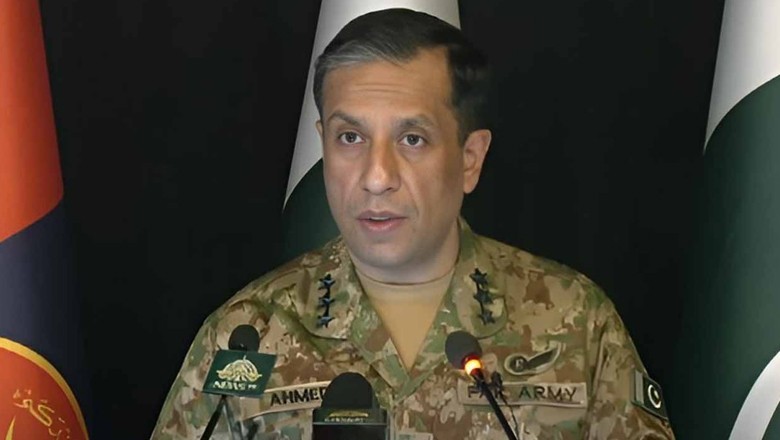
Reviewing the national security landscape, Inter-Services Public Relations (ISPR) Director-General Lieutenant General Ahmed Sharif Chaudhry identified Khyber Pakhtunkhwa (KP) as the most affected province by terrorism, attributing the situation to a “political-criminal-terror nexus.”
Speaking at a press conference on Tuesday to brief the media on security matters and counterterrorism measures, Lt Gen Chaudhry stated that nearly 71% of terrorist incidents in 2025 were reported from KP.
“The main reason behind this is a politically conducive environment that allows the political-criminal-terror nexus to thrive,” he noted.
Counterterrorism Operations in 2025
The ISPR chief said that law enforcement agencies conducted a total of 75,175 intelligence-based operations (IBOs) nationwide last year. A provincial breakdown shows 14,658 IBOs in KP, 58,778 in Balochistan, and 1,739 across other regions.
During 2025, 5,397 terrorism-related incidents were reported in Pakistan, with KP accounting for 3,811 cases, Balochistan 1,557, and other areas 29. The operations resulted in 2,597 terrorists being neutralized.
Lt Gen Chaudhry highlighted ten major attacks targeting civilians and soft targets, noting that Afghan militants were involved in all of them. He emphasized that authorities have accurate intelligence on terrorist locations and operations, and video confessions of arrested terrorists were presented during the briefing.
Among significant incidents, 21 civilians were martyred in the Jaffar Express attack, while a civilian bus in Noshki and an attack on the Frontier Corps headquarters in Quetta, which killed eight civilians, were also cited. The Quetta attack, he said, was carried out by Afghan militants, similar to an assault on the FC headquarters in Peshawar in November.
Lt Gen Chaudhry also referred to the attempted November attack on Cadet College Wana, stating that Afghan terrorists aimed to replicate the 2014 APS Peshawar tragedy.
“This is a war for the entire nation, for every child,” he said, rejecting narratives portraying the fight against terrorism as solely a military effort. “This is not only the army’s war.”
Afghanistan-India Nexus
The ISPR chief highlighted cross-border hostilities, stating that the Afghan Taliban had attacked Pakistani border posts, prompting decisive military responses.
“Afghanistan has become a hub for terrorist operations in the region,” he said, adding that the Afghan Taliban regime has aligned itself with Indian leadership, naming Prime Minister Narendra Modi as a key influence.
Lt Gen Chaudhry warned that the nexus between Fitna al-Khawarij and India became fully evident in 2025, posing a serious threat to regional peace. “If Afghanistan and India wish to confront Pakistan, they are welcome to do so. We will respond,” he asserted.
Reaffirming Pakistan’s resolve to eliminate terrorism, he said, “We have to win this war at all costs, and we will do so with strength.” He highlighted border security measures, noting that dozens of Afghan posts were neutralized within hours during operations at the TTP strongholds in October 2025.
He clarified that operations targeted TTP, not TTA, and recalled assurances given by the Afghan Taliban under the 2020 Doha Agreement to prevent terrorism from Afghan soil. Despite these commitments, Afghanistan remains a sanctuary for Fitna al-Khawarij and Fitna al-Hindustan, where terrorist organizations are nurtured and supported.
Drones and Modern Threats
Lt Gen Chaudhry addressed misinformation regarding drone usage, stating that the Pakistan Army primarily uses drones for surveillance. He noted that armed quadcopters are employed by militants, particularly TTP and Fitna al-Khawarij, with Indian support. Militants use mosques, public areas, and residential neighborhoods as operational bases, often exploiting women and children as human shields.