
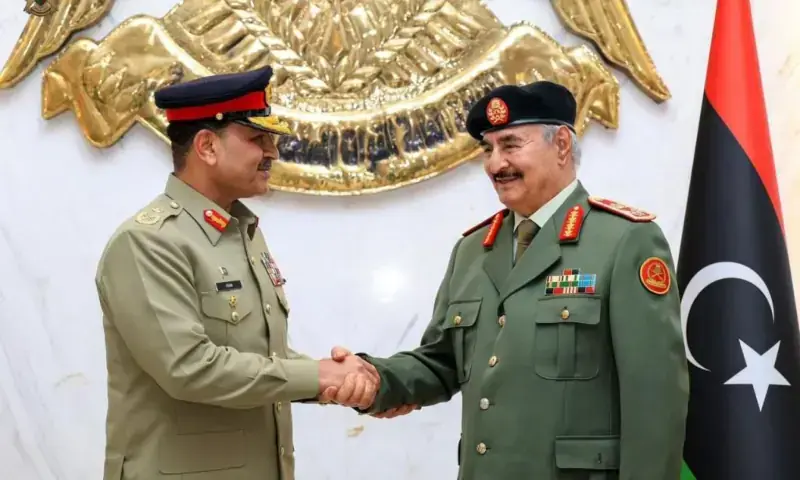
Pakistan has reportedly concluded a multi-billion-dollar agreement to export conventional military equipment to Libya, marking a major milestone as the country joins a limited group of nations engaged in large-scale conventional arms exports.
According to Reuters, the deal—valued at more than $4 billion and described as one of Pakistan’s largest defence export agreements to date—will involve the supply of military hardware to the Libyan National Army (LNA). Officials said the agreement was finalized following a meeting last week in Benghazi between Pakistan’s Chief of Defence Forces, Field Marshal Asim Munir, and Saddam Khalifa Haftar, the deputy commander-in-chief of the LNA.
While Pakistan’s foreign ministry, defence ministry, and military spokespersons did not formally comment on Reuters’ queries, senior military officials characterized the agreement as historic in both scale and financial significance. A draft of the agreement reviewed by Reuters reportedly included the procurement of multiple JF-17 fighter aircraft, jointly developed by Pakistan and China, along with Super Mushak trainer planes used for basic flight instruction.
A Pakistani official told Reuters that the package covers military equipment for land, naval, and air forces and is expected to be delivered over a period of approximately two and a half years. The official added that combat aircraft, including the JF-17, may form a key component of the deal.
Libya has remained under a United Nations arms embargo since 2011, requiring UN approval for any transfer of weapons or related equipment. However, Pakistani military sources defended the transaction, arguing that numerous Western and Middle Eastern countries have continued supplying arms to Libya for years despite the restrictions. They described the embargo as largely ineffective and said the agreement aligns with the vision of the country’s leadership to promote an export-oriented and self-reliant economy.
Libya remains politically divided, with the internationally recognized Government of National Unity led by Prime Minister Abdulhamid Dbeibah controlling much of the west, while the LNA dominates the east and south, including key oil-producing regions, and rejects the authority of the unity government.
Reuters noted that any defence arrangement involving the LNA is likely to draw international attention due to Libya’s prolonged instability following the 2011 NATO-backed uprising that overthrew Muammar Gaddafi and left the country split between rival administrations.
On Sunday, the LNA’s official media outlet reported that it had entered into a defence cooperation agreement with Pakistan encompassing arms supplies, joint training initiatives, and military manufacturing, though no specific details were disclosed. In a televised address aired by Al-Hadath, Haftar announced the beginning of a new phase of strategic military cooperation with Pakistan.
Officials in Benghazi did not immediately respond to requests for comment. Meanwhile, Pakistan continues to pursue the expansion of its defence exports, leveraging decades of counterinsurgency experience and a domestic defence industry that includes aircraft manufacturing and maintenance, armored vehicles, munitions, and naval construction.
In remarks broadcast by Al-Hadath, Field Marshal Asim Munir was quoted as saying that Pakistan’s recent conflict with India had demonstrated the country’s advanced military capabilities to the international community.