
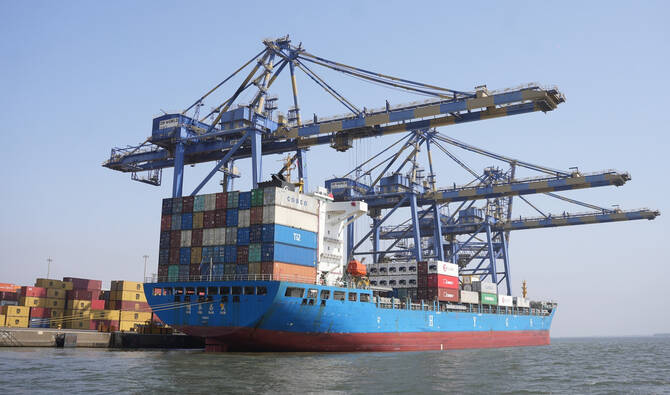
The federal government has decided to hand over the management of the state-owned Pakistan National Shipping Corporation (PNSC) to the military-run National Logistics Corporation (NLC), officials confirmed on Thursday. The move is expected to help Pakistan cut nearly $6 billion in annual freight payments currently made to foreign shipping companies.
The decision follows another major privatization step taken last week, when the government sold a 75 percent stake in Pakistan International Airlines (PIA) to a consortium led by the Arif Habib Group for Rs135 billion ($482 million).
The ongoing push to restructure and privatize state-owned enterprises is a central condition under the International Monetary Fund’s $7 billion financing program for Pakistan, which aims to reduce losses and ease pressure on public finances.
PNSC’s financial performance has weakened in recent months. The corporation recorded a 34 percent drop in profit to Rs3.71 billion ($13.2 million) during the July–September quarter, while revenue from shipping operations slipped 2 percent to Rs9.32 billion ($33 million), according to filings with the Pakistan Stock Exchange. For FY25, profits remained largely flat at around Rs20 billion ($73 million), even as shipping income declined by 18 percent to Rs33.7 billion ($120.3 million).
A PNSC official, speaking on condition of anonymity, said the corporation received formal communication from the government about a month ago directing it to complete preparatory steps before December 30, adding that management control would be transferred to the NLC. An NLC official separately confirmed the development but said further details would be shared later.
Officials at the Ministry of Maritime Affairs and PNSC’s spokesperson declined to comment, citing the absence of an official notification.
Under the PNSC Revitalization and Improvement Plan, the government plans to divest around 30 percent of its shareholding in the shipping company to the NLC, which would then assume a controlling role in its management. As of June 30, the federal government owned 87.56 percent of PNSC, whose 198.1 million shares are listed on the Pakistan Stock Exchange with a market capitalization of Rs109 billion ($389 million).
As part of the restructuring, the NLC is expected to significantly expand PNSC’s fleet from its current strength of 10 vessels to 54 ships over the next five years. Officials said this expansion would allow the national carrier to handle a much larger share of Pakistan’s trade, reducing dependence on foreign shipping lines. At present, PNSC transports only about 11 percent of the country’s commercial cargo, forcing Pakistan to spend roughly $6 billion each year in foreign exchange on overseas freight services.
The plan also includes replacing PNSC’s aging fleet, much of which is nearing the end of its commercial viability and is unlikely to remain profitable beyond 2030. Officials said the initiative would result in the complete replacement of older vessels alongside the induction of new ships.
News of the proposed management shift has already buoyed investor sentiment, with PNSC shares climbing nearly 21 percent over the past two trading sessions. The stock was trading at Rs548.89 ($1.9) on Thursday morning, taking its year-to-date gains to 17 percent.
The government’s broader economic strategy has focused on conserving foreign exchange reserves, which stand at around $16 billion, while managing external account pressures. According to central bank data, Pakistan recorded a current account deficit of $812 million during the July–November period, compared with a surplus of $503 million in the same period last year.
Officials said expanding PNSC’s fleet could boost its share in global maritime freight earnings from $162 million to $1.79 billion. They added that the lack of private-sector participation has limited competition and efficiency in Pakistan’s shipping sector, despite its strong growth potential.
To support the transformation, the government plans to appoint international financial and legal advisers to oversee institutional reforms, with the aim of turning PNSC into a modern, commercially driven, and professionally managed shipping enterprise.