
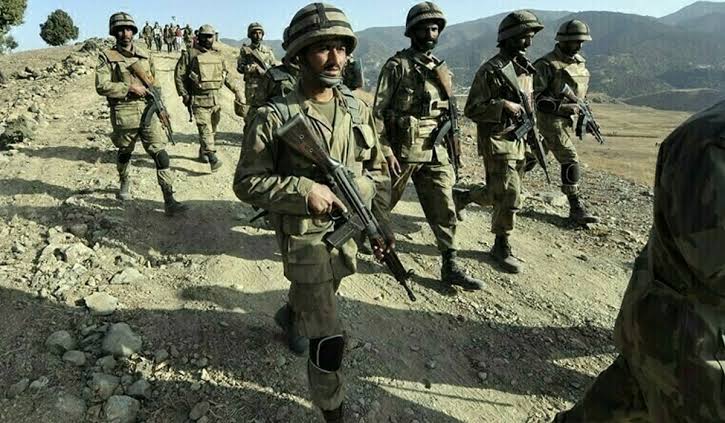
Pakistan’s military said security forces killed ten militants in two separate clashes in Khyber Pakhtunkhwa this week, the latest in a string of counterterrorism operations along the Afghan border during what a security-focused think tank has described as one of the deadliest stretches of violence so far this year.
What Happened
The Inter-Services Public Relations media wing said on August 7 that security forces killed ten militants in two engagements in Khyber Pakhtunkhwa a day earlier, according to Dawn. In the first encounter, a group of militants attempted to attack security checkposts in the Azam Warsak area of South Waziristan. ISPR said troops repelled the attack, killing eight fighters in the exchange of fire. In a separate clash in Dir district, troops killed two more militants, the military’s media wing said.
Key Details
ISPR said weapons and ammunition were recovered from the militants killed in both encounters, and described them as having been actively involved in numerous terrorist activities in the area. The statement said sanitisation operations were continuing in both locations to clear any remaining militants, and that Pakistan’s counterterrorism campaign would continue at full pace.
The military attributed the militants to a group it calls “Fitna al Khwarij,” the term Pakistani state institutions now use to describe fighters linked to the banned Tehreek-i-Taliban Pakistan. ISPR described the group as Indian-sponsored, a characterisation that Dawn’s reporting did not independently verify and that remains unconfirmed by any source beyond the military’s own statement.
President Asif Ali Zardari and Prime Minister Shehbaz Sharif both issued statements after the operations praising the security forces involved. Zardari commended the troops’ professionalism in thwarting the attack in Azam Warsak, while Sharif said the government and the public stood behind the armed forces in the fight against what he described as Indian-patronised terrorism, according to Dawn.
Why It Matters
South Waziristan and Dir sit along one of the most active fronts in Pakistan’s long-running counterinsurgency campaign against Pakistani Taliban-linked militants operating near the Afghan border. Repeated attacks on checkposts, of the kind ISPR described in Azam Warsak, illustrate that militant groups retain the capacity to plan and launch coordinated assaults on security infrastructure despite years of military operations in the region.
The scale of recent violence also matters. According to the Pakistan Institute for Conflict and Security Studies, an Islamabad-based think tank cited by Dawn, July 2026 was the deadliest month of the year so far, with 205 people killed, including 112 security personnel. That figure suggests the current wave of militancy is intensifying rather than winding down.
Technical Background
“Fitna al Khwarij” is the official terminology Pakistani state media and security institutions have adopted in place of naming the Tehreek-i-Taliban Pakistan directly, framing the group in religious rather than political terms. South Waziristan, a former tribal district now merged into Khyber Pakhtunkhwa, has long been a stronghold for militant networks operating across the porous Afghan border, while Dir district, further north, has periodically seen similar infiltration and attacks.
Pakistani security forces typically follow up major clashes with what ISPR calls sanitisation operations, involving searches of the surrounding area for hideouts, weapons caches and any remaining fighters, before formally declaring an area cleared.
Strategic Analysis
The persistence of attacks in South Waziristan and Dir points to the limits of Pakistan’s current counterinsurgency approach, which relies heavily on checkpost defence and reactive clearance operations rather than a sustained territorial hold. Pakistani officials have repeatedly linked the resurgence of TTP-linked violence to the group’s presence in Afghanistan, a claim that has strained relations between Islamabad and the Taliban government in Kabul, though that broader dynamic falls outside the scope of what has been confirmed in this week’s reporting.
The government’s continued use of the term Indian-sponsored terrorism, repeated by both the President and Prime Minister this week, also reflects Islamabad’s consistent framing of domestic militancy as externally directed, a position India has rejected in the past.
Regional or Global Impact
Continued militant violence in Khyber Pakhtunkhwa keeps pressure on Pakistan’s relationship with Afghanistan’s Taliban administration, which Islamabad has periodically accused of sheltering TTP fighters. It also sustains a security burden on Pakistan’s military at the same time it is engaged in diplomatic and humanitarian efforts elsewhere, from Gulf mediation to disaster response, underscoring how stretched the country’s security apparatus has become across multiple fronts simultaneously.
Official Statements
ISPR said the counterterrorism campaign would continue at full pace to eliminate what it called foreign-sponsored and supported terrorism from the country. President Zardari said the nation stands with its security forces and views their sacrifices with appreciation, while Prime Minister Sharif said the government and the nation stand with the security forces in the war against terrorism, according to Dawn.
What Comes Next
ISPR has indicated that sanitisation operations are ongoing in both Azam Warsak and Dir district to eliminate any remaining militants. Given the trajectory described by the Pakistan Institute for Conflict and Security Studies, further operations in Khyber Pakhtunkhwa and neighbouring areas are likely in the near term, though no specific timeline or additional operational details have been released.
Conclusion
This week’s clashes add to what regional analysts already regard as an intensifying year of militant violence in Pakistan’s northwest. With July already marked as the deadliest month of 2026 so far, the killing of ten militants in South Waziristan and Dir offers a tactical success for Pakistani forces, but it does little on its own to resolve the deeper security challenge along the Afghan border.