
By Ghulam Sarwar, Chief Editor, PakSoldier.com
This opinion piece examines Pakistan’s evolving strategic command architecture and the significance of the newly established National Strategic Command in strengthening nuclear security, command and control, and strategic stability.
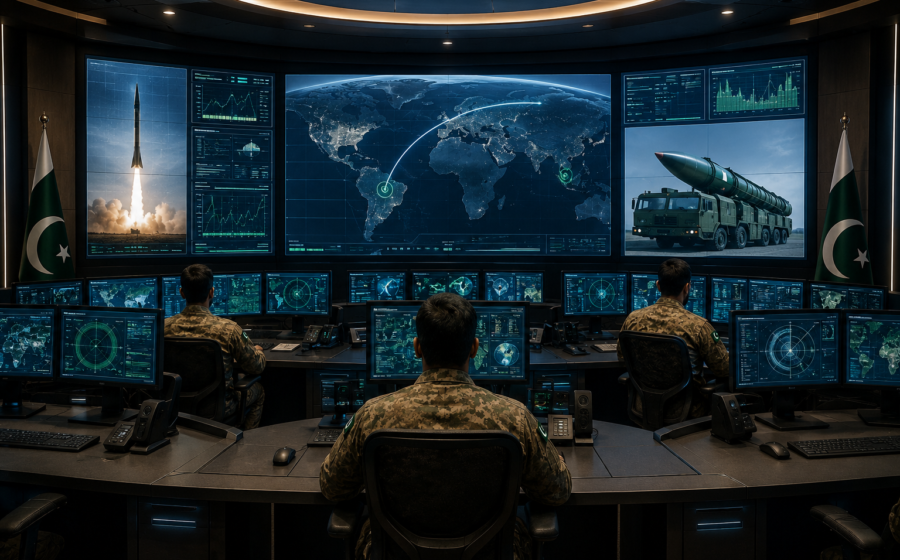
Pakistan has entered a consequential new phase in the evolution of its strategic command architecture. On July 24, 2026, Prime Minister Shehbaz Sharif announced the promotion of Lieutenant General Aamer Raza, HI(M), SBt, then Chief of the General Staff, to four-star General and appointed him Commander National Strategic Command. The government described the position as an important responsibility, while reporting on the restructuring says the new command is intended to oversee the operational integration of Pakistan’s strategic forces.
For a nuclear-armed country located in one of the world’s most demanding strategic environments, this is more than another senior military appointment. It raises a fundamental question: what should a modern strategic command accomplish?
The answer is not simply control over weapons. A credible strategic architecture must preserve political authority, protect strategic assets against physical and cyber threats, maintain reliable command and communications, prevent unauthorized action, support safe stewardship, and ensure that deterrence remains credible precisely so nuclear weapons never have to be used.
Seen from that perspective, the creation of a dedicated four-star National Strategic Command offers Pakistan an opportunity to strengthen an already institutionalized system and adapt it to an era in which strategic security extends far beyond missiles and warheads.


General Aamer Raza and a New Layer of Strategic Command
General Aamer Raza’s appointment matters first because of the institutional weight attached to the new office.
Pakistan’s official nuclear-security framework has long placed the National Command Authority (NCA) at its apex, chaired by the prime minister, with the Strategic Plans Division (SPD) serving as its secretariat. Pakistan’s Ministry of Foreign Affairs describes this as a centralized structure governing strategic assets and nuclear security.
The National Strategic Command should therefore be understood within this broader architecture rather than as a simplistic image of one commander personally controlling Pakistan’s nuclear arsenal.
That distinction matters.
Nuclear stewardship works best when authority, military execution, technical safety, regulation, communications, security and political decision-making exist as mutually reinforcing layers. Pakistan’s challenge is to ensure the new command strengthens those layers instead of creating ambiguity between them.
The appointment of a four-star commander can contribute to that objective by giving strategic-force integration permanent representation at the highest military level.
It also reflects the changing character of warfare. Strategic deterrence today is not solely about the number or range of delivery systems. Cyber operations, electronic warfare, space-based surveillance, precision conventional weapons, drones, artificial intelligence and increasingly compressed decision timelines have transformed the environment in which nuclear command systems must function.
A command structure designed for that environment needs integration without sacrificing safeguards.
Nuclear Weapons Are Ultimately Instruments of Deterrence
Pakistan’s nuclear capability should primarily be understood through deterrence.
A nuclear deterrent exists to convince an adversary that aggression carrying existential consequences cannot produce an acceptable outcome. The most successful nuclear weapon is therefore one that fulfils its strategic purpose without ever being fired.
This creates an unusual military requirement.
Conventional forces are generally organized to fight effectively when ordered. Nuclear forces must be capable enough to deter conflict while simultaneously being governed by extraordinarily stringent controls designed to prevent accidents, miscalculation and unauthorized employment.
That requires a combination of credibility and restraint.
Credibility without restraint creates instability. Restraint without credible capability weakens deterrence.
The National Strategic Command’s long-term significance will depend on how effectively Pakistan maintains that balance.
What Does “Nuclear Security” Actually Mean?
Public discussion often treats nuclear security as guards surrounding sensitive installations. Physical protection is certainly important, but modern nuclear security is much broader.
The IAEA describes nuclear security as a state responsibility and emphasizes national infrastructure designed to prevent nuclear or radioactive material from being used for criminal or unauthorized purposes, while also protecting associated facilities and activities against sabotage.
For a nuclear-armed state, strategic security can consequently be viewed as a system of overlapping protections.
At the broad, non-sensitive level, these include secure command-and-control arrangements, physical protection, personnel reliability, cyber defence, resilient communications, regulatory oversight, emergency preparedness, material accounting and a culture that prioritizes safety and security.
The strongest system is not one that depends upon a single barrier. It is one in which failure of one layer does not automatically compromise the whole structure.
This is where institutional maturity becomes more important than dramatic claims about weapons.
Command and Control: The Brain of Deterrence
The most sophisticated strategic weapon has little deterrent value without dependable command and control.
A nuclear command-and-control system has to satisfy requirements that can appear contradictory. National leadership must retain authority. Legitimate orders must be authenticated. Communications need to remain dependable during crises. Unauthorized action must be prevented. The system must resist cyber intrusion and electronic disruption. And decision-makers must receive reliable information even amid confusion.
That is an immense organizational challenge.
A dedicated strategic commander can potentially improve coordination between operational formations and the country’s wider command architecture, particularly as military operations become increasingly joint across land, air, sea, cyber and other domains.
But centralization should not mean dependence on a single person, communications path or organizational node.
The principle that matters is resilience.
Strategic command should remain functional despite disruption, while preserving political oversight and procedural safeguards. Redundancy, authentication, disciplined communications and institutional continuity are consequently as important to deterrence as visible military hardware.
Pakistan does not need to publicly reveal the classified mechanisms through which these objectives are achieved. In fact, revealing detailed security procedures would itself be irresponsible.
The relevant public measure is whether the architecture demonstrates institutional control.
Physical Security: Protecting Strategic Assets in a Difficult Region
Pakistan has faced terrorism and militant violence for decades, which makes the physical protection of sensitive nuclear and strategic infrastructure particularly important.
Yet security should not be judged through alarmist assumptions.
Strategic facilities are not ordinary military installations, and nuclear security is built around multiple organizational and technical layers. Pakistan’s publicly described nuclear-security framework emphasizes centralized oversight and specialized institutions rather than relying on conventional perimeter security alone.
The new strategic command can reinforce that system by ensuring that emerging threats are assessed jointly and that security doctrine evolves alongside technology.
The threat landscape itself is changing. Small unmanned aircraft, commercially available satellite imagery, cyber capabilities and increasingly sophisticated surveillance technologies create challenges that were far less significant when Pakistan first developed its nuclear deterrent.
Security architecture cannot remain static while threats evolve.
That means continuous modernization rather than complacency.
Cybersecurity Is Now Part of Nuclear Security
Perhaps the least visible but increasingly important strategic domain is cyberspace.
A modern strategic enterprise depends on computers, networks, communications and digital information. That creates enormous benefits, but connectivity also introduces potential vulnerabilities.
For strategic systems, cybersecurity is therefore not merely an information-technology problem. It is part of national deterrence.
A responsible architecture must protect sensitive systems against intrusion, manipulation, espionage and disruption while ensuring that modernization itself does not introduce unnecessary exposure.
There is also a broader lesson here: not every system benefits from maximum connectivity.
In civilian technology, integration is usually treated as progress. In high-consequence strategic systems, isolation, segmentation and carefully controlled interfaces may be more valuable than convenience.
The National Strategic Command will operate in an age when cyber defence has to be treated alongside traditional operational security rather than as a separate technical function.
The Human Factor
Technology receives most of the attention in discussions of nuclear security, but people remain central to every security system.
Personnel reliability, training, professional discipline, institutional culture and clear chains of responsibility are essential because even sophisticated technical protections ultimately depend on human organizations.
This is another reason the elevation of strategic command to a dedicated four-star responsibility can matter.
A senior command does more than issue orders. It shapes doctrine, training priorities, professional standards, readiness and organizational culture.
The strongest nuclear-security culture is one in which personnel understand that security procedures are not bureaucratic obstacles. They are integral to the strategic mission.
Pakistan’s investment in specialized nuclear-security education is relevant here. The Foreign Ministry notes that the country’s National Institute of Safety and Security was designated an IAEA Collaborating Centre in 2022. Pakistan also signed a Practical Arrangement between the IAEA and the Pakistan Centre of Excellence for Nuclear Security in May 2024 to support nuclear-security training activities.
These are meaningful indicators because responsible stewardship is built through institutions and expertise, not slogans.
Safety and Security Are Related, but Different
There is an important distinction between nuclear safety and nuclear security.
Safety focuses primarily on preventing accidents and protecting people and the environment from unintended radiological consequences. Security addresses deliberate acts such as theft, sabotage or unauthorized access.
Both require strong institutions.
Pakistan’s nuclear regulatory system includes the autonomous Pakistan Nuclear Regulatory Authority (PNRA), which oversees civilian nuclear safety and has developed emergency response and recovery capabilities for radiological sources. According to Pakistan’s Foreign Ministry, its regulatory system draws on IAEA safety standards and has undergone international expert peer-review missions.
This matters because Pakistan’s broader nuclear story is not limited to deterrence.
According to the IAEA’s country profile, Pakistan had six operating nuclear power reactors with a combined capacity of 3,262 MWe, with another reactor under construction in the data updated July 20, 2026.
Pakistan therefore has practical national interests in maintaining high nuclear-safety and security standards independent of its military deterrent.
Strategic Forces in the Age of Joint Warfare
Another potential advantage of the National Strategic Command is greater operational integration.
Pakistan’s armed forces increasingly operate in an environment where traditional boundaries between domains are becoming less distinct. Air defence may depend on ground-based sensors. Maritime awareness may draw on aerial surveillance. Cyber systems support conventional operations. Satellites influence navigation and intelligence. Drones connect tactical formations to wider command networks.
Strategic deterrence cannot exist in isolation from this environment.
A dedicated national command can potentially improve common situational awareness and coordination across the strategic enterprise while preserving the distinct responsibilities of the services.
That does not mean every capability should be centralized.
Effective joint command is about integration where integration adds value and specialization where specialization remains necessary.
Pakistan’s Army, Air Force and Navy possess different operational cultures and technical competencies. The objective should be to connect those strengths within a coherent strategic framework, not erase them.
Deterrence Also Requires Survivability
A credible deterrent must remain credible under pressure.
This makes survivability an important conceptual component of strategic stability. An adversary should not believe that a sudden attack could eliminate a country’s ability to respond and thereby create incentives for a first strike.
But survivability is not synonymous with aggressive nuclear posture.
Paradoxically, greater confidence in the survivability of a deterrent can reduce pressure for hasty decisions during a crisis. If national leadership knows its strategic capability is secure and command remains functional, there is less incentive to react to incomplete information.
This is why resilient communications, institutional continuity and secure command arrangements contribute to stability.
The purpose is not to make nuclear conflict easier.
It is to make the perceived benefits of initiating major conflict disappear.
AI, Drones and the Compression of Decision Time
The next decade may be more demanding for nuclear command systems than the previous three.
Artificial intelligence can accelerate intelligence analysis. Autonomous and semi-autonomous systems can operate at unprecedented speed. Hypersonic and precision-strike technologies may reduce warning times. Cyber operations can create uncertainty over whether information is authentic.
The greatest danger may therefore be decision compression.
Technology can deliver more information faster without necessarily producing greater certainty.
A responsible strategic command must resist the assumption that faster decisions are automatically better decisions.
AI may assist with logistics, pattern recognition, maintenance and information processing, but decisions involving nuclear weapons require accountable human political authority. Machines can support judgement; they should not replace human responsibility in matters carrying potentially catastrophic consequences.
For Pakistan, maintaining that distinction will become increasingly important as its wider military modernizes.
Pakistan’s International Nuclear-Security Record Matters
Claims that Pakistan behaves responsibly should be judged against institutions and international engagement rather than asserted as patriotic fact.
There is evidence worth highlighting.
Pakistan participates in international nuclear-security mechanisms and has hosted IAEA activities involving nuclear-security training. Its National Institute of Safety and Security became an IAEA Collaborating Centre, and Pakistan joined the Nuclear Security Contact Group, according to the Foreign Ministry. Pakistan also released an updated overview of its nuclear-security regime in 2024.
Such cooperation matters.
A responsible nuclear state does not have to disclose military secrets. It can nevertheless demonstrate commitment to safety, security, professional regulation, training and international nuclear-security norms.
Pakistan should continue doing so.
The strongest answer to recurring international speculation about Pakistan’s nuclear security is not rhetoric. It is sustained institutional performance.
“Safe Hands” Should Mean Strong Institutions
It is tempting to frame General Aamer Raza’s appointment as proof that Pakistan’s nuclear assets are now “in safe hands.”
There is a more meaningful interpretation.
Strategic assets are safest when they are protected by strong institutions, professional personnel, clear civilian authority, rigorous procedures, resilient technology, independent safety regulation and an enduring security culture.
No nuclear system should depend on the personality of one commander.
General Raza’s importance lies in his ability to strengthen an institutional architecture that must outlast every individual who serves within it.
That is the standard by which the new National Strategic Command should eventually be judged.
If the command improves joint coordination, strengthens readiness, protects command-and-control resilience, incorporates emerging cyber and technological threats and maintains the established role of the NCA, then the restructuring can materially reinforce Pakistan’s strategic security.
Responsibility Is a Strategic Asset
Pakistan’s status as a nuclear-armed country carries enormous responsibility.
Its strategic capability exists in a region containing multiple nuclear powers, unresolved disputes, terrorism risks, rapidly evolving military technologies and recurring geopolitical crises. That environment makes disciplined nuclear stewardship indispensable.
Responsible deterrence means avoiding careless rhetoric.
It means maintaining secure control.
It means investing in nuclear-security expertise.
It means ensuring that modernization strengthens stability rather than undermines it.
And it means recognizing that nuclear weapons are political instruments of last resort whose primary value lies in preventing catastrophic war.
The establishment of the National Strategic Command and the appointment of General Aamer Raza should therefore be viewed not as an occasion for triumphalism, but as an opportunity for institutional consolidation.
The Road Ahead
The National Strategic Command arrives at a time when the definition of strategic power is expanding.
Nuclear weapons remain at the highest level of deterrence, but their security increasingly intersects with cyber defence, space systems, electronic warfare, artificial intelligence, conventional precision strike, missile defence, unmanned systems and information warfare.
Pakistan’s strategic architecture must evolve accordingly.
Yet modernization should preserve several fundamentals: political authority over nuclear decision-making, professional military execution, stringent safety and security practices, resilient command systems, specialized technical expertise and international engagement where it enhances nuclear security without compromising national secrets.
Pakistan’s existing framework provides foundations for that approach. The NCA remains at the apex of the publicly described system, while the SPD serves as its secretariat. Pakistan maintains an independent nuclear regulator for its civilian programme and has developed specialized institutions for nuclear-security training. Its cooperation with the IAEA provides an external dimension to that institutional record.
General Aamer Raza now assumes a newly created position within that evolving architecture.
His greatest contribution will not be measured by public displays of strategic power. It will be measured by something less visible but far more important: whether Pakistan’s deterrent remains secure, controlled, credible and stable through technological change and future crises.
That is what “safe hands” should mean.
Pakistan’s nuclear capability is not merely a collection of weapons. It is a national responsibility requiring permanent stewardship. The strongest demonstration that Pakistan is a responsible nuclear state will therefore continue to come from professional institutions, rigorous security, restraint in crisis and serious engagement with international nuclear-safety and security standards.
The National Strategic Command has an opportunity to reinforce all four.
If it succeeds, the appointment of Pakistan’s first Commander National Strategic Command will represent more than a change at the top of the military hierarchy. It could mark the beginning of a more integrated phase of strategic stewardship — one designed to protect Pakistan’s deterrent, strengthen national security and ensure that the country’s most consequential military capability remains governed by discipline, institutional control and the overriding objective of preventing war.
This is an opinion and analysis article. It discusses Pakistan’s strategic command architecture using publicly available information and does not describe classified operational procedures or nuclear employment mechanisms.