
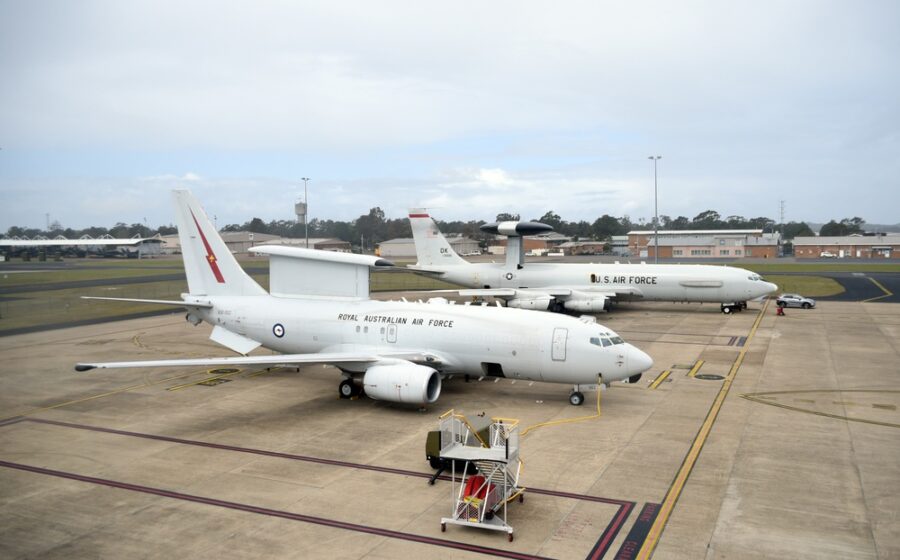
Airborne Early Warning and Control (AEW&C) aircraft have become one of the most decisive force multipliers in contemporary air warfare. Acting as flying radar stations, these platforms detect, track and classify aerial and surface threats far beyond the range of ground-based radar, while simultaneously coordinating friendly fighters, air defence units and naval assets in real time. In an era where air combat is increasingly won or lost before opposing aircraft ever come within visual range, AEW&C capability has shifted from a luxury to a strategic necessity for any credible air force.
What Makes AEW&C Aircraft So Valuable
A typical AEW&C aircraft combines a long-range surveillance radar, identification-friend-or-foe (IFF) systems, electronic support measures and secure datalinks, all mounted on a airframe capable of remaining airborne for many hours. Flying at altitude, the radar horizon extends dramatically compared to ground radar, allowing operators to spot low-flying cruise missiles, fighters and drones long before they cross a border. Beyond detection, the aircraft’s mission crew acts as an airborne command post, directing interceptors onto targets, deconflicting friendly aircraft, and feeding a unified recognized air picture to national air defence networks.
Global Landscape of AEW&C Platforms
Several distinct AEW&C designs dominate global inventories. The United States Air Force operates the Boeing E-3 Sentry, built on a 707 airframe with a distinctive rotating rotodome, and is transitioning toward the E-7 Wedgetail, which uses a fixed, electronically scanned array for continuous 360-degree coverage. Sweden’s Saab Erieye system, mounted on aircraft such as the Saab 2000 and Embraer EMB-145, offers a cost-effective side-looking radar solution favoured by mid-sized air forces. China has fielded a family of systems including the KJ-500 and KJ-2000, while Russia continues to operate the A-50 and its upgraded A-50U variant. Israel’s IAI has also carved out a niche with conformal AEW&C radars integrated onto business jet platforms.
Regional Relevance for Pakistan
For Pakistan, AEW&C capability carries particular strategic weight given the geography of the western border with Afghanistan and the eastern frontier with India. The Pakistan Air Force operates the Saab 2000 Erieye and the Chinese-origin ZDK-03 Karakoram Eagle, both of which extend PAF’s ability to monitor deep into contested airspace and cue fighters such as the JF-17 Thunder and F-16 onto emerging threats. These platforms proved their operational value during periods of heightened tension along the Line of Control, where early detection of intruding aircraft and missiles is critical to a rapid and proportionate response. India’s own fleet of Israeli-origin Phalcon systems mounted on the A-50 airframe, alongside the indigenously developed Netra AEW&C, means the regional AEW&C balance remains an active area of modernization on both sides.
Integration With Networked Warfare
Modern AEW&C aircraft are valuable less for their radar alone and more for the networking they enable. Through secure datalinks, an AEW&C platform can share a single, fused air picture across fighters, surface-to-air missile batteries and naval vessels simultaneously, compressing what used to be a multi-step communication chain into instantaneous shared awareness. This is particularly important in contested electromagnetic environments where enemy jamming may degrade individual radar picture but a networked AEW&C-fed system retains resilience through redundancy and data fusion.
Emerging Trends and the Future
The next generation of AEW&C systems is moving toward active electronically scanned array (AESA) radars offering faster scan rates, better resistance to jamming, and the ability to simultaneously track thousands of targets. There is also growing interest in distributing the AEW&C mission across smaller, less expensive platforms, including high-altitude long-endurance drones equipped with radar payloads, reducing the vulnerability that comes from relying on a handful of large, expensive manned aircraft. As air forces across South Asia and beyond continue to invest in stealth aircraft, hypersonic weapons and drone swarms, the demand for persistent, survivable airborne surveillance and battle management will only grow, cementing AEW&C as a cornerstone of any modern, layered air defence architecture.
Conclusion
AEW&C aircraft represent the connective tissue of modern air power, transforming isolated sensors and shooters into a coordinated, networked force. For air forces operating in contested regional environments, including Pakistan, sustained investment in airborne early warning capability, along with the training and networking required to exploit it fully, remains central to maintaining credible deterrence and air superiority in an increasingly complex threat environment.