
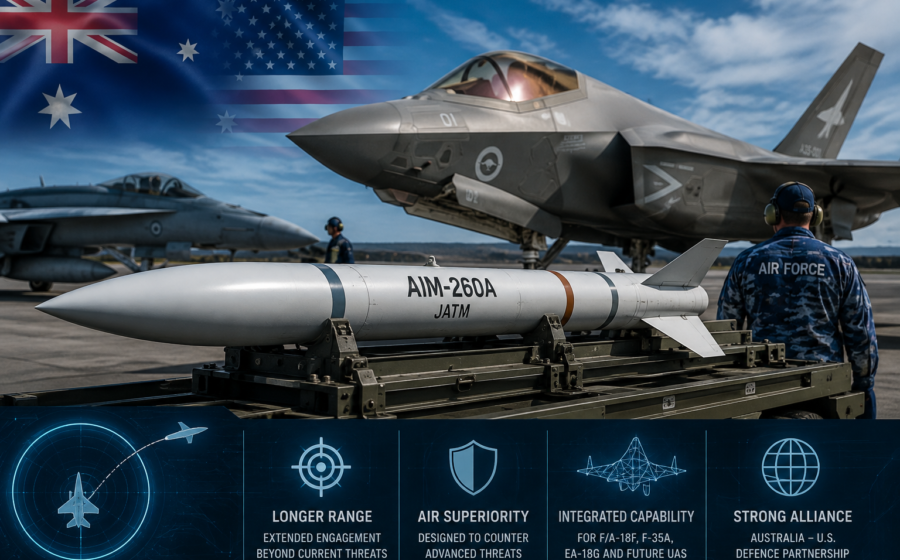
Australia is set to become the first country outside the United States to acquire the AIM-260A Joint Advanced Tactical Missile (JATM), a next-generation air-to-air weapon that will eventually be integrated across several aircraft operated by the Royal Australian Air Force.
Australian Defence Minister Richard Marles announced the acquisition on August 6 while attending the multinational Pitch Black 2026 air exercise in Darwin.
Marles said the new missile would give Australian fighter crews the ability to engage threats from greater distances, strengthen deterrence and better protect the country’s strategic interests.
The decision comes as Australia and the United States increasingly focus on China’s expanding air-combat capabilities. China’s People’s Liberation Army Air Force operates long-range weapons such as the PL-15, while the larger PL-17 is also considered a significant development in the region’s air-to-air missile competition.
The AIM-260 is being developed to provide U.S. and allied aircraft with greater range and capability than older weapons such as the AIM-120 AMRAAM, which has been in service for decades.
Canberra plans to spend approximately A$736 million, equivalent to about US$520 million, to acquire the missiles through the U.S. Foreign Military Sales program. The exact number of missiles included in the Australian purchase has not been disclosed.
The United States approved a possible sale of as many as 450 AIM-260 missiles to Australia on March 17, with the potential deal valued at approximately US$3.16 billion. Because Australia’s announced expenditure is considerably below that figure, the initial purchase is expected to represent only a portion of the approved quantity.
Integration of the AIM-260 is expected to begin with Australia’s F/A-18F Super Hornets. The missile will subsequently be incorporated into the F-35A fleet and EA-18G Growler electronic warfare aircraft.
Australia’s MQ-28A Ghost Bat could also become a future platform for the weapon. The unmanned combat aircraft successfully launched an AIM-120 AMRAAM during testing in December, demonstrating its potential to carry advanced air-to-air weapons.
Lockheed Martin is developing the AIM-260, but many details about the weapon remain classified. The missile is intended to provide improved air-superiority capabilities and significantly greater engagement range than existing U.S. air-to-air missiles. Official imagery of the weapon has also remained limited.
Information concerning the JATM’s propulsion system, seeker technology and precise performance remains secret. Its estimated range is believed to extend beyond 120 miles, although the actual figure has not been publicly confirmed. The missile’s overall dimensions are understood to be broadly compatible with the AMRAAM, allowing it to be carried internally by modern fighter aircraft.
The Australian government said the AIM-260 will strengthen the ability of its air platforms to deter and counter airborne threats. The weapon will supplement Australia’s existing air-to-air missile inventory as well as other missile-based capabilities operated by the Australian Defence Force.
Australian Defence Industry Minister Pat Conroy described the JATM as one of the world’s most advanced air-to-air weapons and emphasized that Australia would become the first operator outside the United States.
Despite the announcement, Australian forces are unlikely to receive the missile immediately. Some reports indicate that operational deployment could take several years, with deliveries potentially not occurring until around 2033.
Australia’s decision could also have broader implications for air forces across the Indo-Pacific. As more U.S. allies in the region operate the F-35 and seek longer-range air-combat capabilities, Canberra’s adoption of the AIM-260 could potentially pave the way for additional international customers in the future.