
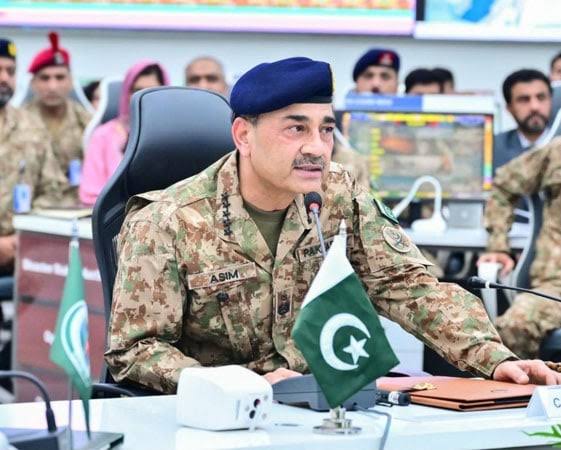
Chief of Defence Forces and Chief of Army Staff Field Marshal Syed Asim Munir visited the National Disaster Management Authority’s headquarters this week, as Pakistan braces for what officials warn could be a difficult stretch of the monsoon season. The visit placed the country’s top military officer directly inside the civilian-run emergency response system at a moment when rising river levels and flash-flood warnings are already in effect across several provinces.
What Happened
Munir visited the National Emergencies Operation Centre at NDMA headquarters on August 4, according to the Express Tribune, where he received a briefing on the country’s disaster preparedness and coordinated response arrangements for the ongoing monsoon season. The NDMA chairman briefed him on the operational capabilities of the centre and its technology-enabled response mechanisms, including a monitoring platform called “Disaster Lens 2026,” which presented the prevailing monsoon situation and multi-hazard monitoring tools, the Inter-Services Public Relations media wing said.
Key Details
According to ISPR, Munir stressed the importance of preparedness, effective inter-agency coordination and swift response to safeguard lives and critical infrastructure. He also reassured the civil administration and the NDMA that the armed forces remained fully prepared to assist with relief, rescue and rehabilitation operations, the Express Tribune reported.
The visit came after Prime Minister Shehbaz Sharif ordered the establishment of a national emergency response mechanism last month to intensify preparations for the monsoon season. At its most recent meeting, that committee directed authorities to maintain maximum preparedness and accelerate relief and rehabilitation efforts, as fresh rain was forecast for northern and central Pakistan, with isolated showers also expected in southeastern Sindh.
The NDMA said water levels in Pakistan’s major rivers were expected to rise significantly in early August, prompting flood alerts across several regions. Streams linked to the Jhelum, Chenab and Ravi rivers could see medium-to-high flows, while water levels in the Ravi and Sutlej would depend partly on releases from reservoirs on the Indian side of the border, according to the authority. It also warned of flash-flood risks in the hill torrents of Dera Ghazi Khan and Rajanpur, as well as seasonal streams in central and southern Khyber Pakhtunkhwa and northern Balochistan.
Why It Matters
Pakistan’s monsoon season has repeatedly tested the country’s disaster response capacity, and the military is routinely called in when civilian resources are overwhelmed. A high-profile visit by the CDF to NDMA headquarters, ahead of the peak flood window rather than after damage has occurred, signals an attempt to get ahead of the problem rather than simply reacting to it once flooding begins.
It also reflects how central the armed forces have become to disaster management in Pakistan, supplying helicopters, boats, engineering units and manpower whenever civilian agencies request support during floods, earthquakes or other emergencies.
Technical Background
The National Emergencies Operation Centre functions as the NDMA’s command hub during major weather events, coordinating information between provincial disaster authorities, the meteorological department and relief agencies. The newly cited platform, Disaster Lens 2026, is described by the NDMA as a technology-enabled system for tracking multiple hazards, primarily riverine and flash flooding, in close to real time.
Flood risk on Pakistan’s major rivers is driven by a combination of monsoon rainfall, glacial melt from the upper Indus basin, and water management decisions upstream. The dependency of the Ravi and Sutlej rivers on releases from Indian reservoirs, which the NDMA specifically flagged, reflects the fact that these rivers originate in Indian-administered territory before flowing into Pakistan, making cross-border water flow information an important input for flood forecasting.
Strategic Analysis
Pakistan’s catastrophic 2022 floods, which killed well over a thousand people and caused tens of billions of dollars in damage by independent estimates, left a lasting mark on how seriously state institutions treat monsoon preparedness. The military’s early engagement this year, well before the traditional peak flooding period in late August, suggests that institutional memory is shaping planning rather than simply post-disaster response.
Munir’s dual role as Chief of Defence Forces and Chief of Army Staff also means that disaster coordination now runs through the same office responsible for broader military strategy, potentially streamlining how quickly resources can be redirected from other tasks if a serious flood emergency develops.
Regional or Global Impact
Flooding in Pakistan can have cross-border implications, particularly given the Jhelum, Chenab, Ravi and Sutlej rivers’ shared origins with India, and any large-scale disaster response could once again draw international humanitarian attention, as it did in 2022. A well-managed monsoon season, by contrast, would reduce the likelihood of Pakistan needing to appeal for outside disaster assistance this year.
Official Statements
According to ISPR, Munir commended the NDMA’s efforts to strengthen Pakistan’s national disaster management capacity during the visit. The military’s media wing said he reiterated the importance of preparedness, coordination and swift response, and reassured civil authorities of the armed forces’ readiness to support relief and rescue operations.
What Comes Next
The NDMA is expected to continue issuing flood alerts as rain persists over northern and central Pakistan, with authorities monitoring hill torrents in Dera Ghazi Khan, Rajanpur and parts of Khyber Pakhtunkhwa and Balochistan closely in the coming weeks. Sindh could also see isolated showers, according to the authority. No specific timeline for the peak of this year’s flood risk has been released beyond the near-term forecasts already issued.
Conclusion
Munir’s visit to NDMA headquarters is a routine but telling episode in Pakistan’s annual monsoon calendar, one that underscores how disaster response has become inseparable from national security planning. Whether this year’s preparation translates into a smoother flood season than 2022 will depend on rainfall patterns still weeks away, and on how efficiently civilian and military agencies coordinate once the water starts rising.