
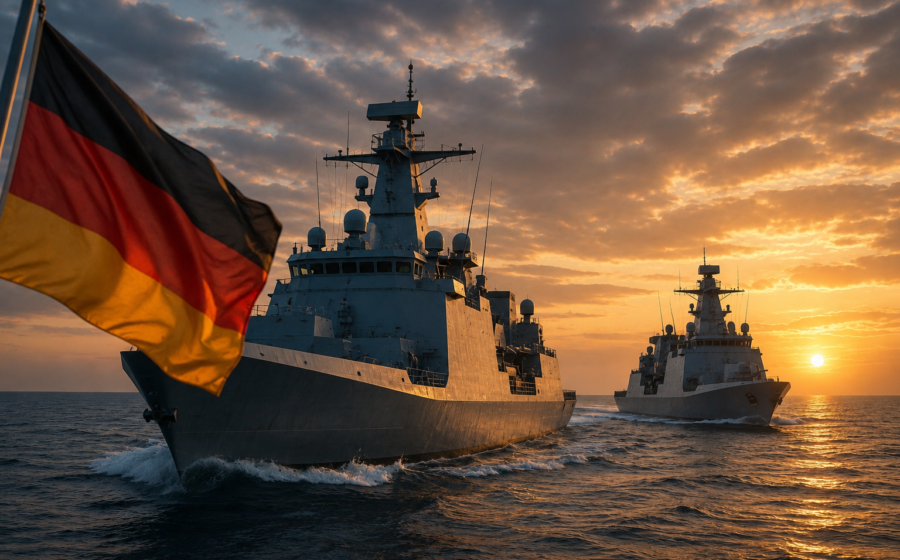
Germany’s government is redirecting two navy vessels away from the Gulf of Aden, where they had been positioned on standby for weeks in anticipation of an eventual post-war security mission in the Strait of Hormuz, as hope fades in Berlin that the conflict involving Iran will conclude soon.
Defense officials ordered the mine hunter Fulda and the support vessel Mosel to redeploy from Djibouti, a major European and international naval hub near the southern entrance to the Red Sea, toward the eastern Mediterranean, the Ministry of Defense announced. The ships and their crews will remain there awaiting further instructions on whether an international Hormuz mission will ultimately proceed at all.
Following the outbreak of the U.S.-Israeli war against Iran in late February, European nations had pledged to commit naval vessels to a multinational mission aimed at securing shipping through the economically critical Strait of Hormuz, over which Iran claims control. Governments involved had set a precondition that hostilities would need to subside enough that their ships would not come under fire in what many considered an otherwise pointless deployment.
According to the Ministry of Defense announcement, Berlin now views the prospect of such a permissive environment as slim, with renewed hostilities having broken out between Iran and the United States following a period of relative calm.
Beyond the geopolitical dimension, navy officials cited a more practical rationale for the redeployment: the cooling systems on both vessels, which rely on seawater, were not designed for the high temperatures found in the Gulf of Aden region. The eastern Mediterranean is considered a more suitable location for ships that were built decades ago for operations in the North Atlantic and waters closer to Germany.
The Ministry of Defense said the redeployment of the Fulda and the Mosel has been coordinated with international partners, with the vessels awaiting an opportunity to travel alongside a capable air-defense escort for the journey to the Mediterranean. During their initial transit to Djibouti in June, the British air-defense destroyer Dragon had provided protective escort through the Red Sea.
Sebastian Bruns, a fellow at the Royal Swedish Society for Naval Sciences, suggested that U.S. President Donald Trump might view the German move as a lack of staying power in the region, though fellow European nations would likely understand the decision given the unpredictable nature of Trump’s statements on potential military strikes and peace prospects. Bruns was critical of the German government’s original decision to send the ships in the first place, describing it as symbolic politics intended to signal support for American efforts despite an unclear security context, and noted that such a role would likely feel like a waste for the crews of these highly specialized mine hunting units.
The German Ministry of Defense said it intends to keep the Fulda and the Mosel available for a future Strait of Hormuz mission, with officials watching for durable indications that a near-term start to such an operation might become possible.