
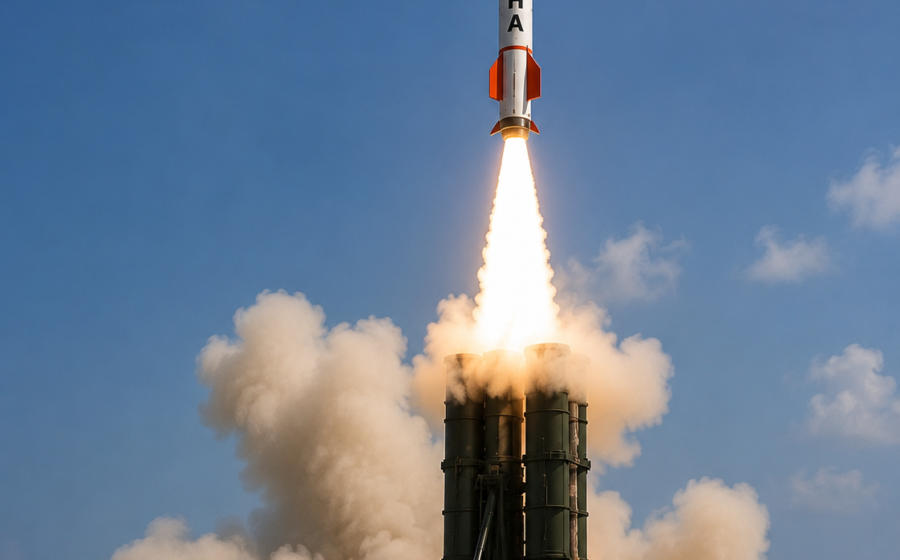
India has taken another step toward developing an indigenous long-range air defence capability after successfully conducting the maiden flight test of the Kusha Long-Range Surface-to-Air Missile (LRSAM).
The Defence Research and Development Organisation (DRDO) carried out the test on July 23, 2026, from APJ Abdul Kalam Island off the coast of Odisha. The missile was tested against an electronic target designed to simulate a high-speed, high-altitude aerial threat and successfully intercepted the simulated target, according to India’s Ministry of Defence.
The test represents an important milestone for Project Kusha, an Indian effort to develop a domestically produced long-range air defence system capable of strengthening the country’s layered air defence network.
What Is Project Kusha?
Project Kusha is being developed by DRDO as an advanced surface-to-air missile system intended to engage threats at significantly longer ranges than many of India’s existing indigenous air defence weapons.
The wider program is aimed at providing protection against multiple categories of aerial threats rather than focusing on a single target type.
According to India’s Ministry of Defence, the Kusha system is being designed to counter threats including:
- Fighter aircraft
- Missiles
- Unmanned aerial vehicles
- Large military aircraft
DRDO laboratories and Indian industry partners are developing the system’s missiles, radars, command-and-control infrastructure and other weapon-system components.
This is particularly important for India’s broader effort to reduce reliance on imported high-end air defence technology.
Kusha Could Strengthen India’s Layered Air Defence
India already operates several types of air defence systems covering different engagement ranges, including the Russian-origin S-400 Triumf and domestically developed systems.
Kusha is intended to expand the indigenous component of that network.
Rather than replacing every existing system, a long-range system such as Kusha could operate as another layer within India’s integrated air defence architecture. Different systems could therefore be tasked with detecting and engaging threats at different ranges and altitudes.
Such layered networks are becoming increasingly important as militaries face a combination of traditional combat aircraft, cruise missiles and unmanned systems.
The development also carries an industrial dimension. Producing a sophisticated long-range air defence system domestically could give India greater control over production, maintenance, upgrades and future deployment compared with relying entirely on imported platforms.
Indigenous Radars and Command Network
Kusha is more than an interceptor missile.
India’s Ministry of Defence says the wider weapon system incorporates domestically developed radars and command-and-control elements, alongside the missiles themselves.
These components are critical to modern air defence operations. Sensors must first detect and track an incoming threat, while command systems process that information and coordinate an engagement before an interceptor can attempt to destroy the target.
Developing those elements together could allow India to build a more integrated domestic air defence ecosystem rather than treating Kusha simply as another missile program.
Why the Kusha Test Matters
The July 23 flight test does not mean that Kusha is already an operational air defence system.
A successful maiden test instead demonstrates progress in the development program. Complex air defence systems typically require additional flight trials, validation against different target profiles, integration testing and user evaluations before they can enter operational service.
However, the successful interception of a simulated high-speed, high-altitude threat provides DRDO with an important test point as development continues.
Indian Defence Minister Rajnath Singh described the test as an important milestone for the country’s defence research sector and said development of an indigenous long-range surface-to-air missile could reduce dependence on imported systems.
Strategic Implications for South Asia
India’s pursuit of a domestically produced long-range air defence system is also relevant to the evolving military balance in South Asia.
Modern air defence networks influence how air forces plan missions, select weapons and employ stand-off capabilities. If Kusha eventually reaches operational maturity, it could add another layer to India’s existing air defence structure and complicate the planning environment for potential adversaries.
For Pakistan, developments in India’s air and missile defence capabilities will therefore remain strategically significant.
Pakistan’s future response does not necessarily depend on matching individual Indian systems platform-for-platform. The broader challenge involves maintaining credible airpower and deterrence while adapting to increasingly dense air defence networks through capabilities such as stand-off weapons, electronic warfare, unmanned systems and appropriate operational tactics.
Much will ultimately depend on Kusha’s demonstrated performance, deployment scale, integration with India’s wider sensor network and the timeline for operational induction.
What Comes Next?
The maiden flight test marks a development milestone rather than the completion of Project Kusha.
Further testing will be needed before the system can move toward operational deployment. Future trials should provide a clearer picture of its engagement capabilities and the maturity of the complete missile, radar and command-and-control architecture.
If India successfully brings Kusha into service, the system could become an important part of its long-term effort to build a more indigenous and multi-layered national air defence network.
For now, the July 2026 test shows that India’s domestic long-range air defence program has moved another step from development toward a potentially deployable capability.