
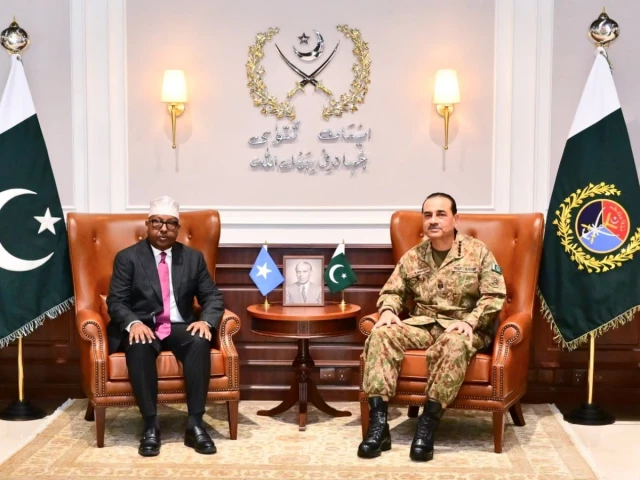
A high-level Somali defence delegation spent two days meeting the heads of all three of Pakistan’s military services this week, in one of the more visible signs yet of a deepening security relationship between Islamabad and Mogadishu. The visit touched Pakistan’s army, navy and air force leadership in turn, reflecting an effort by both countries to broaden cooperation beyond any single branch of the armed forces.
What Happened
Somalia’s Defence Minister, Ahmed Moallim Fiqi, led the delegation that called on Chief of Defence Forces and Chief of Army Staff Field Marshal Syed Asim Munir at General Headquarters in Rawalpindi on August 6, according to Dawn, which cited a statement from the Inter-Services Public Relations media wing. The visit followed separate meetings a day earlier with Chief of the Naval Staff Admiral Naveed Ashraf at Naval Headquarters and with Chief of the Air Staff Air Chief Marshal Zaheer Ahmed Baber Sidhu at Air Headquarters, ISPR said.
The Somali delegation also visited Pakistan Air Force headquarters, where Fiqi was received by the Chief of the Air Staff, according to Shabelle Media Network. He was accompanied by Somalia’s Ambassador to Pakistan, Sheikh Noor Mohamed Hassan, the Commander of the Somali Air Force, Brigadier General Abdirizak Mahmoud Haji, and other senior officials, the outlet reported.
Key Details
At General Headquarters, CDF Munir and the Somali delegation discussed matters of mutual interest, regional security dynamics and measures to enhance bilateral defence and security cooperation, according to the ISPR statement carried by Dawn. Both sides underscored the importance of deepening military-to-military ties and capacity-building initiatives to counter shared security challenges.
At Naval Headquarters, discussions focused on maritime security and bilateral defence collaboration, while talks at Air Headquarters centred on professional collaboration and capacity building, ISPR said. According to Shabelle Media Network, the Pakistan Air Force meeting specifically addressed strengthening air force capabilities, expanding training opportunities and promoting the exchange of expertise between the two countries.
The Somali defence minister praised the Pakistan Navy’s contribution to regional maritime security and the air force’s professionalism and operational capabilities, according to Dawn. The visit built on an agreement reached in January between the two countries’ interior ministries to strengthen cooperation in training, border management, disaster management and a joint strategy against terrorism, when Pakistan’s Interior Minister Mohsin Naqvi met a Somali delegation led by Interior Minister Ali Yusuf.
Why It Matters
The breadth of this week’s engagement, spanning the army, navy and air force over two days, suggests both countries want a defence relationship that goes beyond a single area of cooperation. For Pakistan, expanding security ties with an African partner extends its footprint in a region where it has traditionally had limited military engagement compared with Gulf states.
For Somalia, deeper ties with Pakistan’s armed forces, which have decades of experience in counterinsurgency and peacekeeping, could offer practical support as Mogadishu continues to battle its own homegrown insurgency and works to rebuild its security institutions.
Technical Background
Pakistan has a long history of contributing personnel to United Nations peacekeeping missions in Africa, including in Somalia, and of providing military training to partner states through its staff colleges and specialised institutes. Capacity-building programmes of the kind referenced in this week’s meetings typically involve training slots at Pakistani military academies, technical assistance and periodic joint exercises or exchanges, though neither ISPR nor Shabelle Media Network detailed specific numbers or timelines for any new programmes agreed this week.
Somalia’s own armed forces have been rebuilding gradually since the collapse of central government authority in the early 1990s, with international partners including the African Union, Turkey, the United States and Gulf states all providing varying degrees of training and equipment support.
Strategic Analysis
Security cooperation of this kind is a relatively low-cost way for Pakistan to project influence beyond South Asia and the Gulf, using training and institutional expertise rather than expensive equipment transfers or financial aid. It also gives Pakistan diplomatic goodwill in international forums where Horn of Africa states hold votes and influence.
For Somalia, aligning more closely with Pakistan diversifies its security partnerships at a time when it continues to rely heavily on Western and Gulf support, giving Mogadishu additional options as it rebuilds its military from a low base.
Regional or Global Impact
Closer Pakistan-Somalia defence ties fit into a broader pattern of South Asian and Gulf-adjacent states expanding security relationships in the Horn of Africa, a region whose proximity to the Bab-el-Mandeb Strait and major shipping lanes gives it outsized strategic importance. Any expanded Pakistani training role in Somalia would add to the list of foreign partners already involved in rebuilding the country’s security forces, though the practical scale of Pakistan’s involvement remains unconfirmed pending further detail from either government.
Official Statements
According to ISPR, CDF Munir reaffirmed Pakistan’s commitment to supporting Somalia in strengthening its security apparatus and fostering enduring peace in the region. The Somali delegation, in turn, appreciated Pakistan’s steadfast support and the professional role played by its armed forces in promoting regional peace and stability, Dawn reported.
What Comes Next
Neither ISPR nor Shabelle Media Network specified concrete follow-up steps, such as new training agreements or exercise schedules, arising from this week’s meetings. Given the January agreement between the two countries’ interior ministries and this week’s tri-service engagement, further institutional cooperation appears likely, though its specific form has not yet been announced.
Conclusion
By running the Somali delegation through meetings with all three of its service chiefs in the space of two days, Pakistan signalled that it views the relationship with Mogadishu as a whole-of-forces partnership rather than a narrow, single-service arrangement. Whether that translates into a substantially larger Pakistani training or advisory role in Somalia will depend on decisions still to be made in both capitals.