
Table of Contents
- Top 10 Fighter Jets in the World
- How We Ranked the Best Fighter Jets
- Top 10 Fighter Jets at a Glance
- 1. F-35 Lightning II
- 2. F-22 Raptor
- 3. Chengdu J-20 Mighty Dragon
- 4. Dassault Rafale
- 5. Eurofighter Typhoon
- 6. Sukhoi Su-57 Felon
- 7. Saab JAS 39 Gripen E
- 8. F-15EX Eagle II
- 9. J-10C
- 10. F-16V Fighting Falcon
- Which Is the Best Fighter Jet in the World?
- F-35 vs F-22
- F-35 vs J-20
- Rafale vs Eurofighter Typhoon
- 5th Generation vs 4.5 Generation Fighter Jets
- What Makes a Modern Fighter Jet Powerful?
- Are Faster Fighter Jets Always Better?
- The Future of Fighter Jets
- Frequently Asked Questions
- Final Verdict
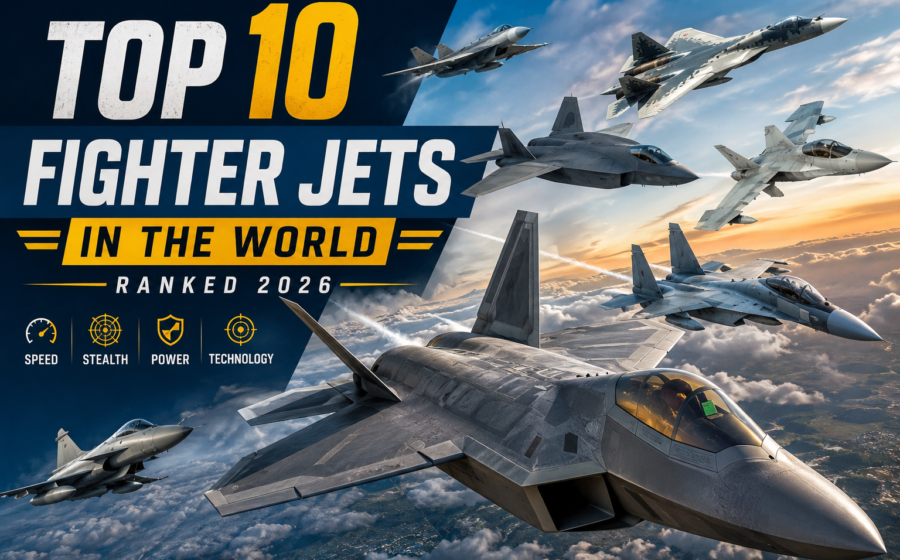
Top 10 Fighter Jets in the World
Modern fighter jets are no longer judged simply by how fast they can fly or how many missiles they can carry.
A modern air-combat aircraft is a highly integrated weapons system combining stealth, radar, electronic warfare, sensors, data links, precision weapons, computing power, networking and pilot decision-making.
That makes the question “What is the best fighter jet in the world?” much harder to answer than it appears.
A fighter designed primarily for air superiority may outperform a multirole aircraft in a pure dogfight. A stealth aircraft may sacrifice some speed for survivability. Another fighter may have outstanding range and weapons capacity but lack the low observability of a fifth-generation aircraft.
For this ranking, the focus is therefore on the overall combat capability of operational fighter aircraft, rather than a single specification.
Based on a combination of technology, survivability, sensors, weapons integration, air-to-air capability, multirole flexibility, range, operational maturity and strategic relevance, these are 10 of the strongest fighter jets in the world in 2026.
The Top 10
- F-35 Lightning II — United States
- F-22 Raptor — United States
- Chengdu J-20 Mighty Dragon — China
- Dassault Rafale — France
- Eurofighter Typhoon — Europe
- Sukhoi Su-57 Felon — Russia
- Saab JAS 39 Gripen E — Sweden
- F-15EX Eagle II — United States
- Chengdu J-10C — China
- F-16V Fighting Falcon — United States
This list should not be interpreted as an official military ranking. There is no universally accepted formula that can objectively determine which fighter jet is “number one.” Different aircraft are optimized for different missions.
How We Ranked the Best Fighter Jets
Before comparing individual aircraft, it is important to understand what makes one fighter better than another.
1. Stealth and Survivability
Stealth has become one of the defining characteristics of modern air combat.
A stealth fighter is designed to reduce its radar signature and make detection and targeting more difficult. Internal weapons bays, carefully shaped surfaces, radar-absorbent materials and other design features can contribute to low observability.
However, stealth does not mean invisibility.
It is better understood as reduced detectability and increased survivability, particularly against sophisticated air-defense systems.
This gives fifth-generation aircraft such as the F-35, F-22 and J-20 an important advantage in heavily contested environments.
2. Sensors and Situational Awareness
A modern fighter needs to know what is happening around it.
Advanced aircraft can combine information from radar, infrared sensors, electronic warfare systems, other aircraft, ground systems and data links.
This process is commonly described as sensor fusion.
The pilot does not simply operate a radar and look for targets. Instead, the aircraft can help construct a broader picture of the battlespace.
3. Weapons
A fighter’s effectiveness also depends heavily on the weapons it can employ.
Important factors include:
- Beyond-visual-range air-to-air missiles
- Short-range air-to-air missiles
- Precision-guided bombs
- Air-to-surface missiles
- Anti-radiation weapons
- Anti-ship weapons
- Internal weapons carriage
- Number of hardpoints
- Weapons integration
- Targeting systems
The aircraft and its weapons should therefore be considered as one system.
4. Air-to-Air Capability
Air-to-air performance remains important.
Factors include:
- Radar performance
- Missile integration
- Maneuverability
- Acceleration
- Energy retention
- Thrust-to-weight ratio
- High-altitude performance
- Helmet-mounted displays
- Electronic warfare
- Situational awareness
However, modern air combat is not simply a traditional close-range dogfight.
5. Multirole Capability
Many modern fighters are expected to perform multiple missions.
A single aircraft may be used for:
- Air superiority
- Air defense
- Ground attack
- Precision strike
- Reconnaissance
- Maritime strike
- Electronic warfare support
- Suppression of enemy air defenses
This is one reason aircraft such as the F-35, Rafale and Gripen are so valuable.
6. Range and Endurance
Range matters because air forces often need to operate far from their home bases.
An aircraft with excellent sensors and weapons is less useful if it cannot reach the area where it is needed.
Combat radius, fuel capacity, aerial refueling capability and endurance are therefore important considerations.
7. Operational Maturity
A fighter can look impressive on paper but still have limitations if it is produced in small numbers or has limited operational experience.
Production scale, training infrastructure, logistics, maintenance and integration into an air force all matter.
8. Upgrade Potential
Modern fighter jets are increasingly software-driven.
An aircraft that can receive new sensors, weapons, electronic warfare capabilities and software upgrades can remain relevant for decades.
Top 10 Fighter Jets at a Glance
| Rank | Fighter Jet | Country | Generation | Primary Strength |
|---|---|---|---|---|
| 1 | F-35 Lightning II | United States | 5th | Stealth, sensors and multirole capability |
| 2 | F-22 Raptor | United States | 5th | Air superiority and stealth |
| 3 | J-20 Mighty Dragon | China | 5th | Long-range stealth and air combat |
| 4 | Dassault Rafale | France | 4.5 | Multirole flexibility |
| 5 | Eurofighter Typhoon | Europe | 4.5 | Air superiority and agility |
| 6 | Su-57 Felon | Russia | 5th | Maneuverability and multirole capability |
| 7 | Gripen E | Sweden | 4.5 | Electronic warfare and operational efficiency |
| 8 | F-15EX Eagle II | United States | 4.5 | Payload, range and weapons capacity |
| 9 | J-10C | China | 4.5 | Modern sensors and multirole capability |
| 10 | F-16V | United States | 4.5 | Proven design and modern avionics |
1. F-35 Lightning II
Country: United States
Manufacturer: Lockheed Martin
Generation: Fifth generation
Primary role: Stealth multirole fighter
If the question is “What is the best overall fighter jet in the world?”, the F-35 Lightning II is one of the strongest answers.
The F-35 was designed around a very different concept from older fighter aircraft.
Rather than simply maximizing speed or maneuverability, the aircraft emphasizes stealth, sensors, information sharing and multirole capability.
The result is an aircraft designed to detect threats, process information and engage targets while attempting to remain difficult for adversaries to detect and target.
The F-35 exists in three principal variants:
- F-35A
- F-35B
- F-35C
The F-35A is the conventional takeoff and landing variant.
The F-35B is designed for short takeoff and vertical landing operations.
The F-35C is optimized for aircraft carrier operations.
That flexibility has made the F-35 one of the most important fighter programs in the world.
Why the F-35 ranks #1
The F-35’s greatest advantage is not raw speed.
It is information dominance.
Its advanced sensors and computing architecture allow the aircraft to combine information from different systems and present it to the pilot in a usable form.
The aircraft also incorporates advanced electronic warfare capabilities and a low-observable design.
Another major advantage is its global fleet.
The F-35 is operated or being introduced by a large group of allied countries, creating opportunities for common training, logistics, weapons integration and data sharing.
That scale is strategically important.
F-35 weaknesses
The F-35 is not the fastest fighter jet in this ranking.
It is also not designed primarily as a close-range dogfighter.
The aircraft is expensive and its maintenance and sustainment requirements have been subjects of continuing debate.
Nevertheless, when stealth, sensors, strike capability, networking and multirole flexibility are considered together, the F-35 is extremely difficult to beat.
Verdict: The best overall combination of stealth, sensors, networking and multirole capability.
2. F-22 Raptor
Country: United States
Manufacturer: Lockheed Martin / Boeing
Generation: Fifth generation
Primary role: Air superiority
If the F-35 is the best overall multirole fighter, the F-22 Raptor is arguably the most formidable pure air-superiority fighter in this ranking.
The F-22 was designed to achieve air dominance.
Its design combines low observability, advanced avionics, high maneuverability, twin engines and supercruise capability.
The aircraft is famous for its ability to maintain supersonic flight without relying continuously on afterburners.
The F-22 can also use thrust-vectoring technology to improve maneuverability.
Why the F-22 is so dangerous
The aircraft’s combination of stealth and air-to-air performance is its defining advantage.
It was designed to detect, engage and destroy opposing aircraft while reducing the opportunity for the opponent to detect and target it first.
Its internal weapons carriage helps maintain its low-observable configuration.
The F-22 also has a powerful radar and advanced electronic systems.
Why it ranks below the F-35
This is one of the most interesting parts of the ranking.
If the question were:
“Which is the best pure air-superiority fighter?”
The F-22 could reasonably be placed at number one.
But this article ranks overall fighter capability, including versatility, global deployment and multirole utility.
The F-22 also has a major strategic limitation: production ended in 2011, and the aircraft has never been exported.
That makes the F-35 much more influential as a global fighter platform.
Verdict: One of the world’s premier air-superiority fighters and arguably the most specialized aircraft on this list for air dominance.
3. Chengdu J-20 Mighty Dragon
Country: China
Manufacturer: Chengdu Aerospace Corporation
Generation: Fifth generation
Primary role: Stealth air-superiority and long-range fighter
The Chengdu J-20 Mighty Dragon is China’s answer to the emergence of fifth-generation American fighter aircraft.
It represents a major shift in Chinese military aviation.
The J-20 uses a large airframe, stealth shaping, internal weapons carriage and advanced sensors.
Its design places considerable emphasis on long-range operations and the ability to challenge high-value enemy assets.
Why the J-20 ranks so highly
The J-20 is particularly important because of its combination of:
- Low-observable design
- Large internal weapons capacity
- Long range
- Advanced sensors
- Modern avionics
- Beyond-visual-range combat potential
Its large size also provides room for fuel and weapons.
That makes the J-20 particularly relevant to China’s strategic requirements in the Indo-Pacific.
Rather than thinking of the J-20 simply as a Chinese equivalent of the F-22, it is more useful to understand it as an aircraft designed around China’s own operational priorities.
J-20 vs F-35
The comparison is complicated.
The F-35 emphasizes multirole operations, sensor fusion and an enormous international support network.
The J-20 appears to emphasize long-range air combat and China’s ability to challenge aircraft and supporting assets at significant distances.
Neither aircraft can be conclusively declared superior in every situation.
Verdict: China’s most important fifth-generation fighter and one of the world’s most significant stealth combat aircraft.
4. Dassault Rafale
Country: France
Manufacturer: Dassault Aviation
Generation: 4.5 generation
Primary role: Multirole / omnirole fighter
The Dassault Rafale demonstrates that a fighter does not need to be a fifth-generation stealth aircraft to remain one of the world’s most capable combat jets.
France designed the Rafale as a highly flexible multirole fighter.
It can perform air-defense, air-to-ground, reconnaissance and maritime missions, while the naval Rafale M is capable of operating from aircraft carriers.
Its combination of performance, sensors, electronic warfare and weapons integration makes it one of the most capable 4.5-generation fighters.
Why Rafale ranks #4
One of the aircraft’s most important features is its SPECTRA electronic warfare and defensive system.
Electronic warfare can be critical when facing modern radars and missile systems.
The Rafale also benefits from an advanced sensor suite, modern weapons integration and a highly developed multirole architecture.
It is capable of carrying a broad range of weapons and can perform different missions during the same deployment cycle.
The aircraft has also achieved considerable export success.
France has successfully marketed the Rafale to multiple countries, demonstrating that the aircraft remains highly competitive internationally.
Rafale’s biggest advantage
Its biggest strength may be the balance between capabilities.
The Rafale is not the stealthiest fighter.
It is not the fastest.
It is not the newest fifth-generation aircraft.
But it performs an exceptionally broad range of missions and has a mature ecosystem of weapons, sensors, training and support.
Verdict: One of the world’s best all-around non-stealth fighters.
5. Eurofighter Typhoon
Countries: United Kingdom, Germany, Italy and Spain
Generation: 4.5 generation
Primary role: Air superiority and multirole combat
The Eurofighter Typhoon was developed by a European consortium involving the United Kingdom, Germany, Italy and Spain.
The aircraft was originally strongly focused on air superiority but has evolved into a capable multirole platform.
The Typhoon is particularly well known for its speed, maneuverability, high-altitude performance and advanced avionics.
It can exceed Mach 2 and has a strong thrust-to-weight ratio.
Why the Typhoon ranks #5
The aircraft combines:
- High speed
- Excellent maneuverability
- Advanced radar
- Infrared search and track
- Electronic warfare
- Modern weapons
- Multirole capability
Its modern upgrades are particularly important.
The Typhoon is not frozen in its original configuration. Continuous modernization allows newer sensors, weapons and avionics to be incorporated.
That makes the aircraft considerably more relevant than its original generation label might suggest.
Typhoon vs Rafale
This is one of the most searched fighter comparisons for a reason.
Both are European 4.5-generation fighters.
The Rafale is generally associated with exceptional multirole flexibility, including carrier operations.
The Typhoon has a particularly strong reputation for air-to-air performance.
In a hypothetical contest, the outcome would depend heavily on weapons, pilot training, supporting aircraft, electronic warfare, rules of engagement and the tactical environment.
Verdict: One of the strongest 4.5-generation air-superiority fighters in service.
6. Sukhoi Su-57 Felon
Country: Russia
Manufacturer: Sukhoi
Generation: Fifth generation
Primary role: Multirole fighter
The Sukhoi Su-57 Felon is Russia’s flagship fifth-generation fighter.
It combines low-observable features with high maneuverability, advanced sensors and internal weapons carriage.
One of the aircraft’s most distinctive characteristics is its emphasis on aerodynamic performance and maneuverability.
The Su-57 also uses thrust-vectoring technology.
Su-57 strengths
The aircraft was designed to perform both air-to-air and air-to-ground missions.
Its strengths include:
- High maneuverability
- High speed
- Long range
- Internal weapons carriage
- Advanced radar systems
- Infrared sensors
- Electronic warfare
- Multirole capability
The Su-57 has also been developed alongside a broader Russian effort to modernize combat aviation.
Why it ranks sixth
The major challenge is scale.
The Su-57 has not reached the enormous production scale of the F-35.
That matters because air power is not determined solely by the capabilities of one aircraft.
A fighter force needs:
- Spare parts
- Training
- Maintenance
- Weapons
- Infrastructure
- Qualified pilots
- Support aircraft
- Logistics
The Su-57 remains a highly capable design, but its smaller fleet and more limited international ecosystem affect its position in an overall ranking.
Verdict: Russia’s most advanced operational fighter design and one of the world’s leading fifth-generation aircraft.
7. Saab JAS 39 Gripen E
Country: Sweden
Manufacturer: Saab
Generation: 4.5 generation
Primary role: Multirole fighter
The Gripen E is one of the most interesting fighter aircraft because it focuses heavily on efficiency, flexibility and modern electronic warfare.
Sweden developed the Gripen around the requirements of a relatively small air force that needed an aircraft capable of operating efficiently from dispersed locations.
The result is a compact fighter with modern avionics and strong networking capabilities.
Why the Gripen E deserves a top-10 position
The Gripen E incorporates:
- AESA radar
- Advanced electronic warfare
- Modern data links
- Infrared search and track
- Beyond-visual-range weapons
- Multirole capability
- High operational flexibility
One of the aircraft’s biggest selling points is its operating philosophy.
It was designed with relatively rapid turnaround and dispersed operations in mind.
That can be extremely valuable during a conflict where conventional airbases may become targets.
Gripen E vs F-35
The Gripen is not a stealth aircraft in the same class as the F-35.
However, comparing them solely on stealth misses the point.
The Gripen can offer a different combination of cost, flexibility, electronic warfare, weapons and operational simplicity.
For countries that cannot or do not want to operate a large fifth-generation fleet, the Gripen E provides a sophisticated alternative.
Verdict: One of the world’s most capable and intelligently designed 4.5-generation fighters.
8. F-15EX Eagle II
Country: United States
Manufacturer: Boeing
Generation: Advanced 4.5 generation
Primary role: Air superiority and multirole strike
The F-15EX Eagle II demonstrates why older fighter designs should not automatically be considered obsolete.
The original F-15 first flew in the 1970s, but the F-15EX is a heavily modernized aircraft incorporating modern avionics, electronic warfare and weapons capabilities.
Its greatest advantage is payload and weapons capacity.
Why the F-15EX is powerful
The F-15EX can carry a very large weapons load and has considerable range.
Its twin-engine design also provides substantial performance.
The aircraft is particularly interesting when considered alongside fifth-generation fighters.
Instead of replacing every traditional fighter with a stealth aircraft, an air force can combine stealth platforms with heavily armed non-stealth aircraft.
A stealth fighter can provide sensing and targeting information while a heavily armed aircraft contributes additional weapons capacity.
That creates a powerful force structure.
Why it ranks eighth
The biggest disadvantage is obvious.
The F-15EX does not have the low-observable characteristics of the F-35 or F-22.
In a heavily defended environment, stealth can provide a major advantage.
But outside those circumstances, the F-15EX’s enormous payload, range and modern electronics make it highly relevant.
Verdict: A powerful weapons truck and one of the world’s most capable advanced 4.5-generation fighters.
9. Chengdu J-10C
Country: China
Manufacturer: Chengdu Aerospace Corporation
Generation: 4.5 generation
Primary role: Multirole fighter
The J-10C is a modernized version of China’s J-10 fighter family.
It has evolved considerably from the original J-10 and incorporates modern avionics and weapons.
The aircraft is especially important because it provides China with a modern single-engine fighter capable of performing a wide range of missions.
J-10C capabilities
The J-10C is associated with:
- AESA radar
- Modern electronic warfare
- Advanced air-to-air missiles
- Multirole capability
- Digital avionics
- High maneuverability
The aircraft’s relatively compact design makes it different from large twin-engine fighters such as the J-20 and Su-57.
Why it ranks ninth
The J-10C may not possess the stealth characteristics of the J-20 or F-35.
However, it provides a sophisticated combination of sensors, weapons and maneuverability.
Its importance also extends beyond China’s own air force because the aircraft has become part of China’s broader defense-export portfolio.
Verdict: A highly capable modern 4.5-generation fighter that demonstrates how competitive non-stealth aircraft remain.
10. F-16V Fighting Falcon
Country: United States
Manufacturer: Lockheed Martin
Generation: 4.5-generation configuration
Primary role: Multirole fighter
The F-16 Fighting Falcon is one of the most successful fighter aircraft ever produced.
Its original design dates back decades, but the F-16V configuration demonstrates how an established fighter can remain relevant through modernization.
The F-16V incorporates modern avionics and an AESA radar, significantly improving its ability to operate in contemporary air-combat environments.
Why the F-16 remains important
The F-16 has several major advantages:
- Huge international user base
- Mature logistics
- Extensive pilot training ecosystem
- Large weapons selection
- Proven airframe
- Modern upgrade options
- Relatively compact design
- Multirole capability
Its enormous global fleet also means that many air forces already possess the infrastructure necessary to operate the aircraft.
Why it ranks tenth
The F-16V cannot match fifth-generation aircraft in stealth.
It is also based on an older airframe design.
But dismissing it because of its age would be a mistake.
The F-16 has received decades of improvements, and the Viper configuration gives the aircraft modern sensors and avionics.
Its operational maturity and enormous global ecosystem remain major advantages.
Verdict: A remarkably adaptable fighter that remains relevant decades after its first flight.
Which Is the Best Fighter Jet in the World?
There is no single answer because “best” depends on the mission.
If overall capability is the deciding factor, the F-35 Lightning II has one of the strongest claims to the number-one position.
If the question is pure air superiority, the F-22 Raptor becomes an extremely strong candidate.
For long-range stealth air combat, the J-20 is one of the most important aircraft to consider.
For multirole flexibility, the Rafale is exceptional.
For European air superiority, the Eurofighter Typhoon remains a formidable platform.
For maneuverability and Russia’s fifth-generation capability, the Su-57 deserves attention.
This is why rankings should always explain the methodology rather than simply declaring one aircraft “the best.”
F-35 vs F-22
The F-35 and F-22 are often compared because both are American fifth-generation fighters.
But they were designed for different priorities.
| Feature | F-35 | F-22 |
| Primary emphasis | Multirole | Air superiority |
| Generation | 5th | 5th |
| Stealth | Extremely high | Extremely high |
| Supercruise | Limited compared with F-22 | Major capability |
| Variants | A, B and C | One principal operational variant |
| Carrier/STOVL capability | Yes | No |
| International operators | Numerous | None |
| Production | Large-scale | Ended |
| Main advantage | Sensors and multirole flexibility | Air dominance |
The F-22 is arguably superior for pure air-to-air dominance.
The F-35, however, is more versatile and has become a much larger international program.
That is why the F-35 takes the number-one position in this overall ranking.
F-35 vs J-20
The F-35 and J-20 represent two different approaches to fifth-generation fighter design.
The F-35 was developed around multirole operations and sensor fusion.
The J-20’s large airframe and design characteristics emphasize long-range missions and air combat.
A real-world comparison would depend on factors that cannot be captured by a specification table.
These include:
- Pilot training
- Supporting aircraft
- AWACS
- Tankers
- Ground radar
- Electronic warfare
- Missiles
- Data links
- Rules of engagement
- Geographic environment
Therefore, simply saying “F-35 wins” or “J-20 wins” oversimplifies the question.
Rafale vs Eurofighter Typhoon
The Rafale and Eurofighter Typhoon are two of Europe’s most important modern fighter aircraft.
Both are 4.5-generation fighters.
The Typhoon has a particularly strong air-to-air pedigree and excellent aerodynamic performance.
The Rafale is exceptionally flexible and was designed from the beginning for a broad range of missions, including naval operations.
| Category | Rafale | Eurofighter Typhoon |
| Country | France | European consortium |
| Generation | 4.5 | 4.5 |
| Primary strength | Multirole flexibility | Air superiority |
| Carrier variant | Yes | No |
| Stealth | Reduced signature, not fifth-generation stealth | Reduced signature, not fifth-generation stealth |
| Electronic warfare | Strong | Strong |
| Air-to-air capability | Excellent | Excellent |
| Multirole capability | Excellent | Excellent |
The better aircraft depends heavily on the mission.
5th Generation vs 4.5 Generation Fighter Jets
One of the biggest misunderstandings in military aviation is that every fifth-generation fighter automatically defeats every fourth-generation or 4.5-generation fighter.
Reality is much more complicated.
Fifth-generation aircraft
Typical characteristics include:
- Low observability
- Internal weapons carriage
- Advanced sensors
- Sensor fusion
- High-end networking
- Advanced electronic warfare
- Integrated avionics
Examples include:
- F-22
- F-35
- J-20
- Su-57
4.5-generation aircraft
These aircraft may lack full fifth-generation stealth but can possess extremely advanced:
- AESA radar
- Electronic warfare
- Data links
- Infrared sensors
- Weapons
- Cockpit systems
- Missile warning systems
Examples include:
- Rafale
- Eurofighter Typhoon
- Gripen E
- F-15EX
- J-10C
- F-16V
The difference is therefore not simply old versus new.
A modern 4.5-generation fighter can remain extremely dangerous when supported by airborne early warning aircraft, electronic warfare, ground-based radar and other networked systems.
What Makes a Modern Fighter Jet Powerful?
The most important change in military aviation is the shift from platform-centric warfare to network-centric warfare.
In the past, pilots often depended heavily on what they could personally see through their aircraft’s sensors.
Today, an aircraft can potentially receive information from a much larger network.
That network can include:
- Other fighter aircraft
- AWACS
- Satellites
- Ground radars
- Naval vessels
- Unmanned aircraft
- Electronic warfare platforms
- Command centers
The fighter therefore becomes one component of a much larger combat system.
Stealth
Stealth can increase survivability by making detection and targeting more difficult.
Radar
Modern AESA radars provide advanced detection and tracking capabilities and can support multiple missions.
Electronic Warfare
Electronic warfare can help an aircraft detect, disrupt or defend against electromagnetic threats.
Data Links
Data links allow aircraft and other platforms to exchange information.
Missiles
Modern air-to-air missiles have transformed beyond-visual-range combat.
Sensor Fusion
Sensor fusion can reduce the pilot’s workload while improving the quality of the tactical picture.
Pilot Training
Even the most advanced fighter jet is ultimately operated by trained personnel.
Training, doctrine, maintenance and support can have an enormous impact on combat effectiveness.
Are Faster Fighter Jets Always Better?
No.
Speed remains important, but it is only one part of fighter performance.
For example, a fighter might have an extremely high top speed but still be disadvantaged if it is easy to detect.
A slower stealth aircraft may be able to approach a threat with a lower probability of detection.
Similarly, an aircraft with a huge weapons load may be more valuable in a particular mission than a faster aircraft carrying fewer weapons.
Modern fighter effectiveness depends on a combination of:
Detection + survivability + information + weapons + range + training + support.
This is why the fastest fighter jet is not necessarily the best fighter jet in the world.
The Future of Fighter Jets
The next major revolution in military aviation is already taking shape.
Future fighter programs are increasingly exploring the combination of:
- Artificial intelligence
- Unmanned aircraft
- Autonomous systems
- Loyal wingmen
- Advanced sensors
- Improved stealth
- Directed-energy technologies
- Longer-range weapons
- Networked combat systems
The concept of the traditional fighter pilot may also change.
Instead of controlling only one aircraft, future pilots could potentially command or coordinate multiple unmanned systems.
This could create a force where a manned fighter acts as the central decision-making platform while unmanned aircraft perform scouting, electronic warfare, deception or other missions.
Sixth-generation fighter jets
The emerging sixth-generation concept goes beyond simply making a faster aircraft.
Programs such as the US Next Generation Air Dominance effort, Europe’s FCAS and the UK’s/Italy’s/Japan’s GCAP represent broader attempts to develop interconnected combat-air systems.
The future fighter may therefore be better understood as a system of systems rather than simply a single aircraft.
That is why the top fighter jets of the future may be judged less by their maximum speed and more by their ability to operate as part of a sophisticated combat network.
Frequently Asked Questions
What is the best fighter jet in the world?
The F-35 Lightning II is one of the strongest candidates for the best overall fighter jet because of its combination of stealth, sensor fusion, networking, multirole capability and international operational scale.
However, the F-22 Raptor may be considered superior for specialized air-superiority missions.
What is the most advanced fighter jet in the world?
The answer depends on how “advanced” is defined. The F-35 and F-22 are among the most advanced operational Western fighters, while the J-20 and Su-57 represent major fifth-generation developments from China and Russia.
Is the F-35 better than the F-22?
Not in every category. The F-22 has exceptional air-superiority capabilities, while the F-35 emphasizes multirole capability, sensors, networking and international interoperability.
Is the J-20 a fifth-generation fighter?
Yes. The Chengdu J-20 is generally classified as a fifth-generation stealth fighter.
Is the Rafale a fifth-generation fighter?
No. The Rafale is generally classified as a 4.5-generation fighter. It nevertheless has highly advanced sensors, electronic warfare systems and weapons integration.
Is the Eurofighter Typhoon a fifth-generation fighter?
No. The Eurofighter Typhoon is generally classified as a 4.5-generation fighter, although modern upgrades have significantly increased its capabilities.
What is the fastest fighter jet in the world?
The answer depends on whether historical aircraft, prototypes and operational aircraft are included. Speed alone also does not determine overall combat effectiveness.
What is the most powerful fighter jet?
There is no universally accepted “most powerful” fighter. Different aircraft excel in different missions. The F-22, F-35, J-20, Rafale, Typhoon and Su-57 are all highly capable but optimized around different requirements.
What is a fifth-generation fighter jet?
A fifth-generation fighter generally combines low observability, advanced sensors, sensor fusion, modern avionics, networking and internal weapons carriage.
What is a 4.5-generation fighter jet?
A 4.5-generation fighter is an advanced development of fourth-generation fighter technology. These aircraft often feature AESA radar, modern electronic warfare, advanced weapons, data links and improved avionics without possessing the full stealth characteristics associated with fifth-generation aircraft.
Which fighter jet has the best stealth?
The exact radar cross-section and other sensitive details of operational fighters are not publicly known with precision. The F-22 and F-35 are widely regarded as among the world’s most capable operational stealth fighters.
Which fighter jet has the longest range?
Range depends on configuration, fuel, weapons, altitude, mission profile and whether aerial refueling is available. Large fighters such as the J-20, F-15 family and Su-57 are designed for substantial range, but published figures should be treated carefully.
Which fighter jet has the best dogfighting capability?
The F-22 is widely regarded as one of the strongest dogfighting and air-superiority platforms because of its combination of thrust, maneuverability, stealth and avionics. However, a modern air battle is not necessarily decided by close-range maneuvering.
Can a 4.5-generation fighter defeat a fifth-generation fighter?
Yes, depending on the circumstances. Combat effectiveness depends on sensors, weapons, pilot training, electronic warfare, supporting aircraft, geography and tactics. Generation labels are useful but do not guarantee victory.
Top 10 Fighter Jets in the World: Final Ranking
After considering stealth, sensors, weapons, maneuverability, range, multirole capability, operational maturity and strategic importance, the ranking is:
| Rank | Aircraft | Country | Generation | Best Known For |
| 1 | F-35 Lightning II | USA | 5th | Overall multirole capability |
| 2 | F-22 Raptor | USA | 5th | Air superiority |
| 3 | J-20 Mighty Dragon | China | 5th | Long-range stealth combat |
| 4 | Dassault Rafale | France | 4.5 | Multirole flexibility |
| 5 | Eurofighter Typhoon | Europe | 4.5 | Air-to-air performance |
| 6 | Su-57 Felon | Russia | 5th | Maneuverability and multirole capability |
| 7 | Gripen E | Sweden | 4.5 | Electronic warfare and flexibility |
| 8 | F-15EX Eagle II | USA | 4.5 | Weapons capacity and range |
| 9 | J-10C | China | 4.5 | Modern multirole capability |
| 10 | F-16V Fighting Falcon | USA | 4.5 | Proven design and modernization |
Final Verdict
The era when fighter jets could be ranked simply by speed, altitude or weapons load is over.
The most capable modern fighters are sophisticated networks of sensors, computers, weapons, electronic warfare systems and human decision-making.
The F-35 Lightning II earns the number-one position in this ranking because it offers an unusually broad combination of stealth, sensor fusion, networking, multirole capability and global operational relevance.
The F-22 Raptor remains a benchmark for air superiority.
The J-20 represents China’s rapidly expanding fifth-generation fighter capability.
The Rafale and Eurofighter Typhoon demonstrate that highly advanced 4.5-generation fighters remain extremely relevant.
The Su-57 represents Russia’s fifth-generation approach, while the Gripen E demonstrates how a smaller, highly networked fighter can remain competitive.
The F-15EX, J-10C and F-16V show another important trend: advanced fourth-generation designs are not disappearing simply because fifth-generation fighters exist.
Ultimately, there is no fighter jet that is guaranteed to defeat every other aircraft.
The outcome of a real air-combat scenario depends on the aircraft, pilot training, weapons, sensors, electronic warfare, supporting aircraft, intelligence, logistics and the environment in which the battle occurs.
That is what makes modern military aviation so fascinating.
The world’s best fighter is not necessarily the aircraft with the highest top speed.
It is the aircraft that can detect the threat, understand the battlespace, survive the engagement and successfully complete its mission.
Sources & Further Reading
The ranking above is an analytical assessment rather than an official government ranking. Publicly available information about military aircraft can vary considerably, particularly for radar performance, radar cross-section, electronic warfare, weapons ranges and operational readiness.
For current aircraft specifications and program information, readers should consult manufacturer information and official defense sources where available. Current 2026 public reporting also shows that fighter-jet comparisons vary substantially depending on whether analysts prioritize stealth, air superiority, multirole capability, price, fleet size or operational availability.
Editorial note: Aircraft specifications and procurement prices can change between variants, production batches and individual contracts. Published figures should therefore be treated as approximate rather than absolute.