
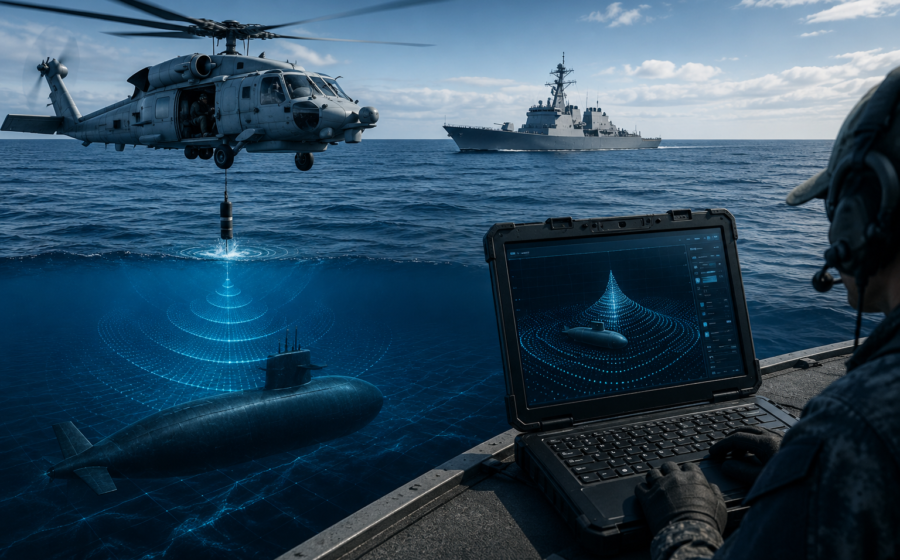
The U.S. Navy has tested an artificial intelligence-based sonar system designed to help detect and identify submarines during the multinational Rim of the Pacific, or RIMPAC, exercise held in July.
The technology, known as SensorMAX, was developed by Lockheed Martin. It applies artificial intelligence and machine learning to acoustic information collected by underwater sensors. The system can analyze the incoming signals, improve its detection model when new sounds are identified, and then send updated information wirelessly to aircraft and other anti-submarine warfare (ASW) platforms.
During the exercise around Hawaii, Navy MH-60R helicopters deployed sonobuoys to collect underwater acoustic data. SensorMAX processed information from those sensors and helped helicopter crews distinguish potential targets.
According to Lockheed Martin, operators on the ground were able to train the system to recognize unfamiliar underwater sound patterns within minutes. Once the updated model was ready, the revised information could be transmitted through an encrypted data connection directly to aircraft and other elements of the fleet.
Lockheed Martin has characterized SensorMAX as a portable artificial intelligence-based sonar specialist for the Navy.
The company says the system continuously receives acoustic information from multiple underwater sensors and provides that information to aircrews while also sending relevant data to ground-based operators. When a previously unidentified acoustic signature appears, personnel can classify the signal, use it to retrain the AI model and send a relatively small software update back to the aircraft.
One of the system’s reported advantages is its ability to monitor as many as eight sonobuoy feeds simultaneously. Lockheed Martin says this represents roughly twice the capacity of older systems.
The company also said that retraining the AI model can take less than five minutes, potentially allowing crews to adapt quickly when operating conditions or underwater acoustic signatures change.
SensorMAX is designed to combine information from different types of sensors, giving it applications beyond airborne anti-submarine missions. Lockheed Martin said the technology could also support naval and ground-based operations.
The company is working with FUSE Inc. on secure software delivery, allowing deployed aircraft to receive updated AI models and mission software without having to stop ongoing operations.
Lockheed Martin said the demonstration also highlighted the potential for AI systems that are not tied to a single platform or sensor type. Such technology could allow future naval forces to combine acoustic sensors from different sources and potentially expand the area used to protect high-value military assets while shortening the time required to identify and engage underwater threats.
The United States is not alone in exploring artificial intelligence for anti-submarine warfare. China has also been reported to be researching AI-based systems for detecting submarines. Chinese media claimed that researchers had developed technology capable of combining information from several sources, including sonobuoys and environmental measurements such as water temperature and salinity.
The growing use of AI in undersea warfare reflects a broader effort by major militaries to process increasingly large volumes of sensor data and identify potential submarine threats faster than traditional methods allow.