
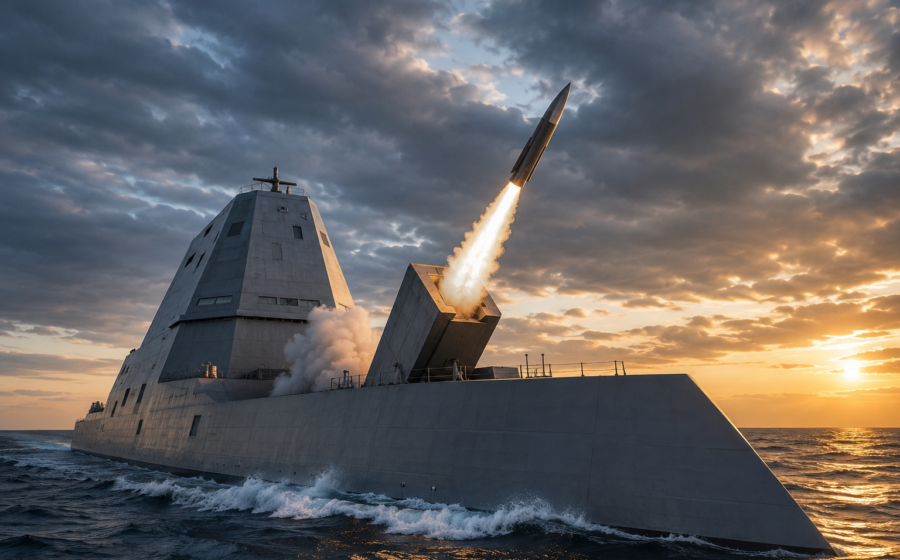
The U.S. Navy’s costly effort to fit hypersonic missiles aboard its three Zumwalt-class destroyers is running two years behind schedule, according to government auditors. Beyond issues with the destroyers themselves and the missiles, the Navy and Army are reportedly failing to properly coordinate work on the joint Conventional Prompt Strike missile program, with missile flight testing originally scheduled for 2025 now pushed back to 2027.
A Government Accountability Office report warned that despite recent successes in testing the CPS missile, the Navy faces several programmatic challenges tied to developing, delivering and deploying the missile aboard the DDG-1000 destroyers, including rising costs, schedule delays, reliability issues with the ships themselves, and ongoing production challenges for the missile.
After escalating costs and capability concerns led to the DDG-1000 program being cut from a planned 32 ships to just three, the Navy decided in 2022 to arm the Zumwalts with CPS boost-glide hypersonic missiles. The CPS system uses a two-stage booster to launch a high-altitude glider capable of striking a target thousands of miles away in 30 minutes or less. Two Zumwalts have already been delivered, with the third scheduled for 2028. CPS missiles are also slated to arm Virginia-class attack submarines, while the Army fields a land-based version known as the Land-Range Hypersonic Weapon.
Modifying the destroyers to accommodate hypersonic missiles and vertical launch tubes has added both cost and delay. On one ship, for example, the contractor needed far more cabling than initially planned, cutting and removing more cabling from the forward section than anticipated to accommodate the CPS missile launch tube installation, according to GAO. The report also noted that the DDG-1000 class ships rely on unique radar, combat and network systems that are costly and difficult to sustain, compounded by unreliable power systems and difficulty obtaining spare parts.
Even with some successful flight tests from land-based facilities, the CPS missile program has encountered its own difficulties. The projected cost of the missiles has risen sharply, from a 2020 Navy estimate of $31 billion for 262 missiles to a current estimate of $41 billion for just 224 missiles. GAO noted that Lockheed Martin, the CPS missile body’s prime contractor responsible for production integration, faces significant production issues that must be resolved to build missiles at the anticipated rates and costs, citing problems with heat-resistant coatings, substandard parts and insufficient production capacity, with the factory currently capable of producing only six or seven missiles annually rather than the desired twelve.
Building the missile has also proven too complex for some workers, according to the report, which noted that work instructions are largely written as engineering specifications provided to workers who have recently graduated from high school or vocational school, a situation Navy production oversight officials called unreasonable to expect employees to fully understand.
In theory, the Army should have an easier path with its own LRHW missile, which mainly differs from CPS in its launcher, using a hot-launch system rather than the cold-gas ejection system that propels CPS from its tube before ignition. However, GAO pointed to a concerning lack of coordination between the two services, noting that while the Navy is responsible for producing the missile body, the Army separately hired its own consultant to study how to increase production. The report concluded that the Navy cannot make decisions in isolation, since the Army is procuring its own missiles and manages key aspects of production, and warned that without a joint development and procurement strategy, the two services risk both additional delay and inefficient use of taxpayer funds.
The GAO findings highlight the mounting technical, financial and coordination challenges confronting the U.S. hypersonic weapons program, raising questions about whether the Navy and Army can align their efforts closely enough to deliver the capability on a realistic timeline.